Chief Executive Officer of Oro Oil Ghana Limited, Dr Maxwell Commey, has called on the government to use the US$500 million World Bank-supported Oil Palm Development Finance Window to expand palm oil production and processing across more regions of Ghana.
According to Commey, the financing should prioritise smallholder farmers, community-level processing mills and other decentralised infrastructure to ensure that the benefits of the programme reach more communities.
He said the proposed financing presented an opportunity to expand Ghana’s palm oil sector, create jobs and improve incomes for farmers while reducing the country’s dependence on imported vegetable oil.
“Ghana’s palm oil sector is already largely smallholder-driven, accounting for the majority of fresh fruit bunches and a significant share of crude palm oil. The US$500 million World Bank facility, designed with long-term concessional financing and a focus on sustainable development, presents a historic opportunity to build on this foundation by decentralising production and processing,” he said.
Commey said a large-scale plantation project covering more than 100,000 hectares and projected to create over 300,000 jobs could not be concentrated in only two regions.
He therefore proposed a model that combines existing mills with smallholder and outgrower schemes, suggesting that mills could process about 70 per cent of their capacity while the remaining 30 per cent could be allocated to small and outgrower farmers.
He said such a model could create jobs for women and young people in farming communities, as well as in transport, maintenance, marketing and small-scale processing.
He identified the Western, Central, Ashanti, Eastern, Volta and Oti regions, as well as parts of the Bono East and Ahafo regions, as areas that could benefit from expanded palm oil production.
Commey said stronger smallholder participation could also increase farmers’ incomes by allowing them to retain more value through their own processing or by selling fresh fruit bunches to nearby mills.
He added that decentralising production could speed up implementation of the proposed project within its planned 10-year period and help the government secure additional land for sustainable plantation development through partnerships with local communities.
According to him, expanding domestic palm oil production could also improve food security and reduce Ghana’s reliance on imported vegetable oil, thereby conserving foreign exchange.
He further identified lower transportation costs, reduced post-harvest losses and improved oil quality as potential benefits of processing fresh fruit bunches closer to production areas.
Commey said decentralised processing could also support rural economies and promote more balanced regional development by keeping more value addition within producing communities.
He noted that modern processing technologies, including biogas systems, could help reduce smoke pollution and emissions while improving the efficiency of local mills.
He said the financing facility, which is expected to support up to 70 per cent of project costs, could be used to fund community mills, smallholder outgrower partnerships, rural infrastructure, improved seedlings, mechanisation and cleaner processing technologies.
“Large centralised plantations have their place, but history shows that well-supported smallholder and decentralised systems deliver broader livelihood gains and more inclusive growth,” Commey said.
“By channelling this World Bank financing toward decentralisation — paired with access to quality inputs, extension services, gender-inclusive associations, and transparent markets — we can unlock rural prosperity, strengthen supply chains, and move decisively toward self-sufficiency.”
Commey, who has more than 27 years of experience in the agro-industrial sector, called on the government, the Tree Crops Development Authority (TCDA), Development Bank Ghana and private-sector operators to consider decentralised models in deploying the financing facility.
Business News of Tuesday, 22 September 2026
Source: www.ghanaweb.com
Decentralise palm oil production with $500m World Bank fund – Oro Oil CEO
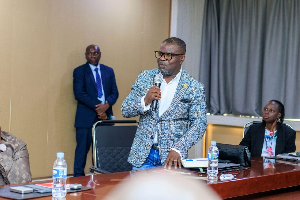 Dr Maxwell Commey, Chief Executive Officer of Oro Oil Ghana Limited