As Ghana marks Founders’ Day on September 21, 2026, the country reflects on the individuals whose contributions helped shape its history and journey to independence.
Among the prominent figures in that history is Dr Kwame Nkrumah, Ghana’s first President.
He is widely remembered for his role in the struggle for independence and his vision of a united and independent Africa.
However, there are several lesser-known details about the early life and political journey of the man who became one of Africa’s most influential nationalist leaders.
Here are five things you probably didn’t know about Dr Kwame Nkrumah.
1. His father was a goldsmith and his mother was a trader
Dr Kwame Nkrumah was born into a family whose livelihood was rooted in traditional trade.
His father, Kofi Ngonloma, was a goldsmith, while his mother, Elizabeth Nyaniba, was a retail trader and fishmonger.
2. He was the only child of his mother
Dr Nkrumah was born into a polygamous family. His father had several wives and children.
He was the only child of his mother, who strongly encouraged him to pursue formal education.
Born in September 1909 at Nkroful in the Gold Coast, now Ghana, Nkrumah was baptised a Roman Catholic and spent nine years at a Roman Catholic elementary school near Half Assini.
He later attended Achimota College, where he completed his education before beginning his career as a teacher.
3. He started out as a teacher
Politics was not Nkrumah’s first profession.
Upon graduating from Achimota College in 1930, he worked as a teacher at Roman Catholic junior schools in Elmina and Axim. He also taught at a seminary.
His years as a teacher came before his eventual emergence as one of the leading figures in Ghana’s independence struggle.
4. He spent years studying in the United States
Nkrumah left the Gold Coast in 1935 to pursue further education in the United States.
He enrolled at Lincoln University in Pennsylvania and graduated in 1939. He later obtained master’s degrees from Lincoln University and the University of Pennsylvania.
His time in the United States was also significant politically, as he became increasingly immersed in ideas around nationalism, socialism and Pan-Africanism.
5. Marcus Garvey was one of the thinkers who influenced him
During his time in the United States, Dr Nkrumah studied the works of several political thinkers, including Karl Marx and Vladimir Lenin.
Nkrumah’s policies should inform contemporary development - Prof Ntewusu
He also studied the ideas of Marcus Garvey, the Jamaican-born Pan-Africanist and Black nationalist leader.
Nkrumah became deeply involved in political organising while abroad and eventually became president of the African Students’ Organization of the United States and Canada.
He later described himself as a “nondenominational Christian and a Marxist socialist.”
He returned home as an organiser for the UGCC
Dr Nkrumah’s return to the Gold Coast in 1947 did not immediately make him the leader of the Convention People’s Party.
Instead, he had been invited to serve as General Secretary of the United Gold Coast Convention (UGCC), which had been formed by J.B. Danquah and others to campaign for self-government through constitutional means.
Here's the plan Nkrumah had that could transform Ghana today
After returning home, Nkrumah travelled across the Gold Coast, addressing meetings and organising support for the UGCC.
His eventual break with the organisation led to a new chapter in his political career and the formation of the Convention People’s Party.
Nkrumah would go on to lead the Gold Coast to independence from British colonial rule in 1957 and become Ghana’s first Prime Minister before later serving as President.
JKB/MA
Watch Theo Kpakpo Allotey battle Facundo David Garcia from bell to bell
General News of Monday, 21 September 2026
Source: www.ghanaweb.com
Founders' Day: 5 things you probably didn’t know about Dr Kwame Nkrumah
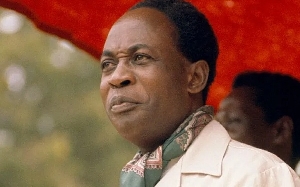 Dr Kwame Nkrumah, Ghana’s first President