A Gender Expert has called for stronger measures to address the continued underrepresentation of women in governance, particularly at the local level, despite the passage of the Affirmative Action (Gender Equity) Act, 2024 (Act 1121).
At a Citizens’ Forum themed *“Constitutional Reform and Democratic Decentralisation in Ghana: The Way Forward for Local Governance,”* Becky Ahadzi, Coordinator of the Affirmative Action Law Coalition, drew attention to the persistent gender gap at the District Assembly level. She cited the 2023 District Assembly Elections, where only 4.1 per cent (259) of those elected were women, compared with 95.9 per cent (5,984) men.
“District Assembly decisions determine whether markets operate, water flows, roads remain accessible, and local economies survive. Women are not only beneficiaries but also bear the direct consequences of these choices every day, yet they remain largely excluded from the decisions that shape their survival. Therefore, their underrepresentation is not simply a question of numbers, but a question of who has a voice where local decisions are made,” Ms Ahadzi stated.
She argued that the objective of the Affirmative Action (Gender Equity) Act is not to replace democracy with quotas, but rather to strengthen Ghana's democracy by making it more representative and inclusive. Drawing on the experiences of countries such as Uganda, Rwanda and Sierra Leone, she advocated for electoral mechanisms and systems that would expand opportunities for women to participate effectively in local governance, influence decision-making, and build the political experience and leadership capacity necessary for higher levels of public office.
With the 2030 gender parity deadline drawing closer, Ms Ahadzi said Ghanaian women cannot afford to wait for further studies to confirm their underrepresentation in governance. She noted that the country remains well below the 30 per cent representation target and argued that the 2027 District Assembly Elections offer a critical opportunity to accelerate progress towards greater inclusion. “We cannot deepen democracy by decentralising power and leaving women behind,” she stated.
The Forum, organised by the Institute for Democratic Governance (IDEG) in partnership with Oxfam, provided a platform for governance experts, civil society representatives, women and youth groups, and other stakeholders to discuss practical solutions to strengthening Ghana’s democratic decentralisation.
General News of Sunday, 20 September 2026
Source: www.ghanaweb.com
Create mechanisms to increase women's representation in constitutional reforms – Gender expert
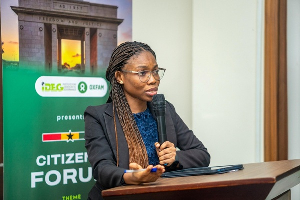 Becky Ahadzi is the Coordinator of the Affirmative Action Law Coalition