Kenyan lawyer, academic and Pan-Africanist Professor Patrick Loch Otieno (PLO) Lumumba delivered a blistering assessment of Africa’s continued economic dependence on foreign powers on September 16, 2026.
PLO Lumumba said to an audience at the Accra Metropolitan Assembly, “the continent must return to the fundamentals of Kwame Nkrumah’s vision” if it is ever to achieve true economic independence.
Professor Lumumba was the guest speaker at the Padmore-Dubois Nkrumah Memorial Lecture 2026, held under the theme “Africa’s Economic Independence in a Changing Geopolitical Landscape.”
The event, attended by Ghana’s Minister for Tourism, Abla Dzifa Gomashie, Volta Regional Minister, James Gunu, and other dignitaries, was organised to honour the legacy of Ghana’s first president and the Pan-African ideals championed alongside him by George Padmore and W.E.B. Du Bois.
Opening his address, Lumumba said it was “almost impossible to talk about Africa without mentioning” Nkrumah, insisting that the warnings the former Ghanaian leader issued in the 1960s remain strikingly relevant today. “That is how relevant Kwame Nkrumah is,” he said, noting that Africa currently has 50 active conflicts standing in the way of its economic independence.
Reflecting on Nkrumah’s insistence at the founding of the Organisation of African Unity that the continent needed “one country, one army, one foreign policy,” Lumumba lamented that Africa instead settled for a weaker union. “We came out with the Organisation of African Unity. Weak. Some described it as a toothless bulldog,” he said.
The professor devoted much of his lecture to what he described as Africa’s continued economic subjugation by global powers, accusing Western financial institutions of dictating policy to African finance ministers. “Then they experiment their ideas on us… they call it Moody’s, and Moody’s is always moody when he’s dealing with Africa,” he said.
He went on to criticise what he called Africa’s habit of shuttling between foreign capitals in search of partnership, from Washington and Beijing to Istanbul, Doha and Brussels, without securing genuine benefit for the continent.
“Africans are busy moving from place to place like the proverbial yo-yo, like the rolling stone that gathers no moss,” he explained, arguing that Africa cannot gain economic independence “until the day that we retreat and begin to go to the fundamentals.”
Lumumba also pointed to the continent’s failure to industrialise, feed itself, or trade meaningfully with itself despite decades of continental declarations, from the 1980 Lagos Plan of Action to the Abuja Declaration on health and the Malabo Declaration on food security.
“Sub-Saharan Africa, with nearly 800 million people, little South Korea with a population of 58 million generates more electricity than all of us,” he said.
Turning to Nkrumah’s enduring legacy, Lumumba recalled that both former African Union Commission chairperson Nkosazana Dlamini-Zuma and former Tanzanian president Julius Nyerere had publicly apologised to Nkrumah in later years for doubting his vision of continental unity.
“How many men are buried thrice? Only Kwame Nkrumah, because the ideas transcend time,” he declared, explaining that Africa’s continued rediscovery of Nkrumah’s ideas, most recently through Agenda 2063, was itself evidence of how far ahead of his time the late leader had been.
Despite his sharp criticism of Africa’s economic drift, Lumumba struck a note of resolve as he closed his address. Posing the question of whether economic independence was still achievable for the continent, he answered firmly.
“Will we achieve it? Can we achieve it? Yes we can,” he emphasised, urging African leaders and finance ministers to revisit Nkrumah’s writings to rediscover the urgency with which he once pursued African unity.
The lecture forms part of continuing efforts by the Padmore-Dubois Nkrumah Memorial Lecture series to keep alive the Pan-African ideals of Nkrumah, Padmore and Du Bois, and to press African leaders to translate political independence into lasting economic self-reliance.
General News of Friday, 18 September 2026
Source: gbcghanaonline.com
Kwame Nkrumah is the only man who has been buried thrice - PLO Lumumba
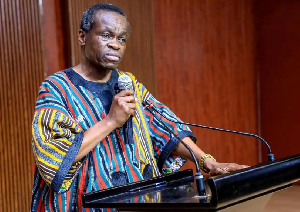 Professor Patrick Loch Otieno (PLO) Lumumba is Kenyan lawyer, academic and Pan-Africanist