Business confidence in Ghana has remained firm as a sharp decline in borrowing costs, stronger credit growth, lower inflation and continued economic expansion improve the operating environment for firms, although high input costs remain a major constraint on businesses.
Finance Minister Dr Cassiel Ato Forson said last week that government’s focus is moving beyond macroeconomic stabilization to increased production, investment and job creation, as improved economic conditions provide the basis for stronger private-sector activity.
“Stabilization was never the destination. It was the price of entry. Ghana has paid that price. What comes next is the work that changes lives at scale, the work of transformation,” he said during an engagement with the National Development Planning Commission.
The Bank of Ghana’s latest published Business Confidence Survey showed the Business Confidence Index at 107.7 in June 2026, broadly unchanged from 108.1 in April and above the 105.5 recorded in June 2025, indicating businesses have maintained optimism about economic conditions despite continued pressure from operating costs.
The central bank said concerns among businesses over higher input costs were being offset by declining lending rates and optimism about the country’s economic growth prospects.
The resilience in business confidence follows a significant improvement in financing conditions over the past year, with the benchmark used by banks in pricing loans falling by more than half.
The Ghana Reference Rate (GRR) dropped to 10.18 percent in September 2026 from 23.80 percent in September 2025, representing a decline of 13.62 percentage points, or about 57 percent, within a year.
It also declined from 10.61 percent in August, as lower Treasury bill and interbank rates continued to pull down the benchmark. The Treasury bill component used in calculating the September reference rate fell to 4.8856 percent from 5.7881 percent, while the interbank rate eased to 10.20 percent from 10.23 percent.
The reduction has lowered the benchmark from which commercial banks price cedi loans, providing businesses with better financing conditions compared with a year earlier. Actual lending rates, however, continue to depend on borrowers’ risk profiles and margins charged by individual banks.
Bank of Ghana data show the improvement in financing conditions is being accompanied by a strong recovery in credit. Gross loans and advances increased by 39.4 percent year-on-year to GH¢124.3 billion in June 2026, compared with growth of only 5.5 percent during the corresponding period of 2025.
Private-sector credit also expanded by 41.2 percent year-on-year, pointing to increased credit flowing to businesses and households.
The increase marks a sharp turnaround from a year earlier, when high lending rates constrained borrowing and gross loans expanded by only 5.5 percent.
Bank of Ghana Governor Dr. Johnson Asiama has also pointed to stronger activity in the productive sectors, saying recent economic indicators show that “the economy has turned a decisive corner.”
“The real sector is showing signs of sustained revival,” the Governor said, pointing to easing inflation, exchange-rate stability and stronger external buffers.
Evidence from businesses themselves also points to resilience in private-sector expectations.
The Association of Ghana Industries’ second-quarter Business Barometer recorded a confidence index of 108.7. Although this was marginally below 109.5 in the first quarter, 42 percent of businesses surveyed said their performance had improved during the quarter, while another 47 percent reported that performance remained unchanged.
Together, 89 percent of businesses reported either improved or unchanged performance, while only 11 percent experienced deterioration.
Expectations for the period ahead were stronger. Seventy-two percent of businesses expect their performance to improve, 26 percent expect conditions to remain unchanged and only 2 percent anticipate deterioration.
The AGI attributed the relatively strong confidence to improving macroeconomic stability and increased confidence in economic management, although businesses continued to identify electricity costs, raw-material prices, taxes and access to finance among their major constraints.
Economic activity has also remained relatively strong. Ghana’s economy expanded by 6.0 percent year-on-year in the second quarter of 2026, keeping economic growth for the first half of the year at about 6.2 percent
Services which account for the largest share of the economy and contain a significant portion of private businesses, expanded by 8 percent during the second quarter. Industry grew by 4.3 percent, while agriculture expanded by 3.9 percent.
Information and communication activity recorded particularly strong growth of 30.9 percent, while manufacturing expanded by 6.6 percent, providing further evidence of increased activity in sections of the private sector.
Inflation has also declined sharply from the levels businesses faced a year earlier. Headline inflation stood at 5.0 percent in August 2026, providing greater predictability for companies in pricing, budgeting and investment decisions.
Input costs remain one of the main concerns identified in the Bank of Ghana survey, while the AGI survey found electricity costs to be the biggest operating challenge reported by businesses. Raw-material costs, taxes, access to credit and infrastructure constraints were also cited.
Access to cheaper credit also remains uneven. Bank of Ghana data on annualized percentage rates show considerable differences in what businesses actually pay for loans after banks add risk premiums and other charges to their base rates.
The reduction in the Ghana Reference Rate therefore does not mean every business is borrowing at 10.18 percent, particularly small and medium-sized enterprises considered higher-risk by lenders.
The significance for businesses is that the benchmark for pricing credit has fallen sharply at the same time that banks are expanding their loan books, creating room for more credit to flow into the private sector if the lower-rate environment is sustained.
Dr. Forson said government’s next economic phase is intended to build an economy that “creates jobs, generates wealth and grows on the strength of what Ghana produces,” with the New Economy programme expected to place greater emphasis on productive investment.
Lower borrowing costs, stronger credit growth and easing inflation have therefore given businesses greater room to finance working capital and investment as economic activity continues to expand.
The direction of borrowing costs over the coming months will also be influenced by the Bank of Ghana’s next monetary policy decision, due by the last week of September, with businesses and lenders watching whether the central bank maintains its current stance or creates further room for an easing in financing conditions.
With bank lending increasing and financing costs already declining, the policy stance adopted by the central bank will be important to how quickly the improvement in macroeconomic conditions feeds through to business investment, operating costs and demand through the final quarter of 2026.
Business News of Thursday, 17 September 2026
Source: economytimesnews.com
Business confidence remains strong as borrowing costs ease
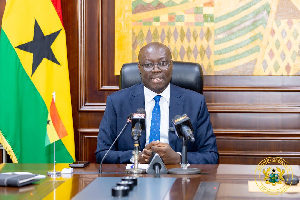 Cassiel Ato Forson is the Minister of Finance