The founder of the Richard Nii Armah Quaye (RNAQ) Foundation, Richard Nii Armah Quaye, has rallied the Ga-Dangme people to unite and contribute their resources, ideas and expertise towards the development of the community.
He said greater unity among the people was necessary to address the challenges confronting the Ga-Dangme community and build a stronger foundation for its future.
Richard Nii Armah Quaye made the call at the launch of the Richard Nii Armah Quaye Ga-Dangme Youth Scholarship Fund, an initiative of the RNAQ Foundation in partnership with the Ga Mantse Foundation.
The fund was launched on Monday, September 14, 2026, at the Mövenpick Ambassador Hotel in Accra to support brilliant but financially disadvantaged Ga-Dangme students pursuing tertiary education.
Speaking at the event, Richard Nii Armah Quaye said he was encouraged by the Ga Mantse, Nii Katamanso, Nii Nungua and other traditional rulers to begin his charitable efforts within the Ga-Dangme community.
He said the decision reflected the need for members of the community to come together and invest in initiatives that could improve the fortunes of the people.
“We lack unity among other virtues as Ga-Dangme people, that is why we are underdeveloped as a people. Let’s unite and build a greater Ga-Dangme,” he said.
He urged individuals and groups within the community to contribute what they could towards a common development agenda.
“Fellow Ga-Dangme people, bring on board everything you have, in order for us to build a formidable Ga-Dangme,” he added.
His call for unity was echoed by Emmanuel Lamptey, a lead of the RNAQ Foundation, who said the scholarship initiative formed part of a broader, long-term effort to bring the Ga-Dangme community together around education and development.
He stressed that greater collaboration among the various traditional authorities did not require the community to abandon the identity or authority of individual stools.
“We do not have to surrender the strength of our own stools or traditions to find a common path. There are moments when our development must bring us together. This is one of those moments,” he said.
The President of the Greater Accra Regional House of Chiefs and Nungua Mantse, Oboade Notse King Professor Odaifio Welentsi III, also called for collective action, identifying education as an important area in which the Ga-Dangme community needed to make progress.
“If there is one major factor that has contributed to the lack of progress in the Ga-Dangme communities, it is education,” he said.
He acknowledged the achievements of Ga-Dangme students and professionals but said financial difficulties continued to prevent some talented young people from pursuing tertiary education.
He described the scholarship fund as a collective response to the challenge.
“Let us therefore regard the Richard Nii Armah Quaye Ga-Dangme youth scholarship fund as our collective response, a pledge that those capable minds in the Ga-Dangme region should not be denied an education for lack of means,” he said.
The Ga Mantse, who was the guest of honour, also identified education as a critical component of efforts to secure a better future for the Ga-Dangme people.
“In order to foster a better tomorrow for Ga-Dangme, education should be a key factor in our development agenda,” he said.
He thanked Richard Nii Armah Quaye for the initiative and called for support for efforts aimed at advancing the community.
The Ga Mantse also pledged to stand with Nii Nungua in promoting unity and urged queen mothers to help mediate disputes among traditional leaders.
Jesse Agyapong, External Consultant to RNAQ Holdings and the Foundation, said the scholarship initiative was conceived partly out of concern over the representation of Ga-Dangme students among tertiary graduates.
He said the concern became particularly evident during an engagement at the Kwame Nkrumah University of Science and Technology (KNUST), where the foundation observed that the proportion of Ga-Dangme students among graduating students was not significant.
“A few months ago, we found ourselves at KNUST … the cohort of Ga-Dangme students who were graduating, the percentage wasn’t significant enough,” he said.
He said subsequent engagements indicated that financial difficulties, including challenges with paying school fees, were limiting the educational progress of some young people.
The scholarship, he explained, was therefore targeted at brilliant and needy students, with the possibility of expanding the initiative beyond tertiary education in the future.
The launch therefore brought together traditional leaders and other stakeholders around a broader message of unity, with education positioned as one of the areas through which collective action could contribute to Ga-Dangme development.
General News of Wednesday, 16 September 2026
Source: metrotvonline.com
Richard Nii Armah Quaye rallies Ga-Dangme behind unity, development agenda
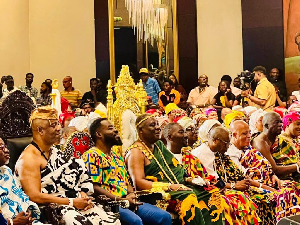 Some of the stakeholders at the event


Entertainment