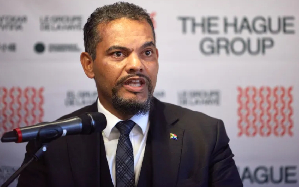
Senior Geomatic Engineer at the Ghana National Petroleum Corporation (GNPC), Emmanuel Boadum Donkor, has revealed that more than one billion barrels of oil and 2.5 trillion cubic feet of gas could potentially be added to Ghana’s production from stranded resources in the Tano Basin.
Speaking to the media on the sidelines of the Esri User Conference West Africa 2026 on Tuesday, September 16, 2026, Donkor said GNPC was using Geographic Information Systems (GIS) to explore ways of developing resources that may not be commercially viable if developed separately.
“With only the Tano Basin that we have done the analysis around, we have been able to identify over 1 billion barrels of oil that we can actually potentially add to our production rate and about 2.5 trillion cubic feet of gas that we can actually add to our current production to boost it,” he said.
GRA targets GH¢260 billion revenue by 2028
He said the resources had been identified through spatial data analysis using GIS, explaining that one of the challenges was the high cost of developing infrastructure for each stranded resource separately.
According to him, GNPC is therefore considering a hub-based approach that would allow several stranded resources to share infrastructure.
“If you take up the CAPEX in terms of developing the infrastructure to extract these stranded resources independently, if you compare it to doing it in the hub way which we are seeking to do, you realise that it brings down the cost of investment and then it actually boosts our confidence to be able to extract these stranded resources,” he explained.
Donkor said GIS was helping GNPC identify where existing petroleum infrastructure could be connected to the stranded resources.
He said this could reduce the amount of new infrastructure required and make some of the resources more attractive for development.
“At GNPC it is a very significant part of us, as our data contains about 80% location information, and that tells you how significant positioning is to our industry,” he stated.
He explained that the system allows GNPC to bring together information on wells, pipelines, roads, settlements, farms and environmentally sensitive areas when planning petroleum projects.
The information can help the Corporation identify suitable locations for infrastructure while taking into account communities, farms and environmentally sensitive areas.
He added that further work and consultations with stakeholders would be required before the identified opportunities could be implemented.
Donkor said the proposed approach forms part of efforts to find new ways of using Ghana’s existing petroleum infrastructure to develop resources that have remained stranded.
ANAS/MA
Technology will be key to improving air traffic management – President Mahama
Business News of Wednesday, 16 September 2026
Source: www.ghanaweb.com
Tano Basin holds over 1 billion barrels of oil, 2.5 trillion cubic feet of gas – GNPC reveals
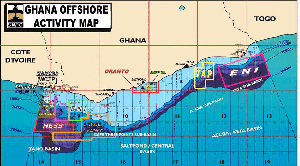 Tano Basin holds over 1 billion barrels of oil, 2.5 trillion cubic feet of gas




Entertainment