A delayed start to southern Ghana’s minor rainy season is putting the country’s second crop cycle under pressure, raising the risk of weaker food production and renewed price pressures as farmers face a shorter window to plant and bring rain-fed crops to maturity.
The Ghana Meteorological Agency (GMet) expects the minor rainy season to begin late to normal across most of southern Ghana, with some coastal areas potentially waiting until the second to fourth weeks of September before the onset of sustained rains.
The delayed onset is being accompanied by expectations of relatively weak rainfall in September, increasing the risk that farmers who depend largely on rainfall could face tighter planting and production conditions during the minor season.
GMet’s September 2026 outlook indicates predominantly below-normal to normal rainfall across most parts of the country, placing additional attention on moisture conditions across southern farming areas during the early stages of the season.
The combination of a delayed onset and weaker rainfall could compress the effective growing period available to farmers, particularly for crops that must be planted early enough to complete critical growth stages before the rains end.
In the Transition Zone, GMet expects the minor-season onset mainly between the second week of August and first week of September. The Forest Zone is expected to experience onset between the fourth week of August and second week of September.
The East Coast faces a later window, with the onset generally expected between the second and fourth weeks of September.
The forecast places food production into focus as Ghana enters a period when output from the minor season helps supplement supplies from the major cropping season.
A weaker second season would have implications beyond farm output.
Lower production of vegetables and other rain-fed food crops could tighten supplies to major markets later in the year and into the early part of 2027, increasing the risk of price increases if domestic production falls short of demand.
The risk is emerging when individual food commodities are already recording sharp price movements despite relatively low overall food inflation.
Ghana Statistical Service data show fresh tomato prices increased 158.3 percent year-on-year in August, making tomatoes the commodity with the highest inflation rate during the month.
Fresh tomatoes alone accounted for 23.1 percent of Ghana’s overall inflation in August, demonstrating how supply problems in a single major food commodity can feed quickly into consumer prices.
The increase occurred even as overall food inflation eased marginally to 3.0 percent in August from 3.1 percent in July.
Headline inflation increased to 5.0 percent from 4.6 percent over the same period.
Market traders have already linked higher tomato prices to supply constraints and reduced rainfall in major producing areas.
In some Accra markets, traders reported that a basket of tomatoes which sold for about GH¢200 during the comparable period last year had risen to as much as GH¢700, while smaller quantities also recorded substantial increases.
The minor-season rainfall outlook therefore adds another supply-side risk to food prices in the months ahead.
Agriculture in Ghana remains heavily dependent on rainfall, leaving crop production exposed when the timing, distribution or duration of rainfall changes.
A late onset does not automatically mean lower production. The final effect will depend on rainfall distribution during the remainder of September, October and November, the duration of dry spells and when the season eventually ends.
But delayed planting can narrow the period available for crops to mature and expose late-planted fields to moisture shortages if rainfall ends before crops complete their growing cycle.
The risk is particularly important for farmers without reliable irrigation who cannot compensate for delayed rainfall by supplying water independently.
GMet’s forecast consequently provides an early warning for farmers to adjust planting decisions to the expected conditions rather than relying entirely on the traditional farming calendar.
The weather risk extends beyond the timing of the onset.
Southern Ghana is also entering the minor season against concerns that rainfall during the latter part of 2026 could be weaker than farmers normally require.
Climate researchers at the University of Energy and Natural Resources have warned that El Niño conditions could increase the probability of below-normal rainfall during the minor season, particularly across southern Ghana.
Previous strong El Niño episodes have been associated with weakened or shortened rainy seasons and moisture stress in parts of Ghana, although the occurrence of El Niño does not mean every producing area will necessarily experience drought.
The minor season provides another production window for farmers after the major rainy season and helps maintain the flow of locally produced food into markets during the final months of the year.
If farmers plant smaller areas because of uncertainty over rainfall, or crops experience moisture stress after planting, the effect could emerge later through reduced market supplies
That could become particularly important for perishable crops, where shortages can translate rapidly into price movements because supplies cannot easily be stored for long periods.
The 158.3 percent increase in fresh tomato prices in August provides an indication of the scale of price volatility that can emerge when supply fails to match market demand.
Weak minor-season production could put part of that improvement under pressure if shortages emerge across important food commodities. The effect would also reach farmers.
Those able to produce successfully under tighter supply conditions could benefit from higher market prices, but farmers whose crops fail or yields decline would face reduced volumes available for sale after already committing resources to seeds, fertilizer, labor and other production costs.
The next several weeks will therefore be critical for southern Ghana’s second crop cycle.
GMet’s forecast does not point to crop failure, but the expected late-to-normal onset and predominantly below-normal to normal September rainfall leave farmers with less certainty over the production window.
Business News of Wednesday, 9 September 2026
Source: economytimesnews.com
Late rains put southern Ghana’s minor-season crops at risk
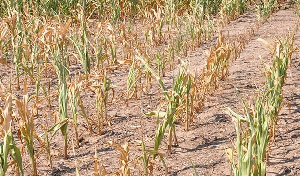 File photo of withered crops