The turnaround in the cedi delivered a GH¢23.73 billion improvement in the foreign-exchange position of state-owned enterprises (SOEs) in 2025, reversing years of currency pressure on state-company finances and contributing to the sector’s return to profitability.
SOEs recorded GH¢11.72 billion in net foreign-exchange earnings during the year, compared with a GH¢12.01 billion foreign-exchange loss in 2024, according to the latest State Ownership Report released by the State Interests and Governance Authority (SIGA).
The GH¢23.73 billion swing came as the cedi strengthened from GH¢14.70 to the US dollar at the end of 2024 to GH¢10.45 by December 2025, providing substantial relief to state enterprises exposed to foreign-currency obligations.
The currency recovery also helped cut consolidated finance costs across the SOE portfolio by 42.49 percent, removing one of the major financial pressures that had weighed on state enterprises during previous periods of exchange-rate depreciation.
Cumulative net profit after tax reached GH¢19.80 billion in 2025, compared with a GH¢2.25 billion loss in 2024, representing a GH¢22.05 billion improvement in one year.
The result ended a four-year cycle of consolidated net losses and marked the strongest financial performance recorded by the SOE portfolio over the latest reporting period.
The recovery had already started at the operating level before the full benefit of the stronger currency emerged.
Profit before interest and tax moved from a GH¢502 million loss in 2023 to GH¢5.80 billion in 2024 before rising sharply to GH¢25.49 billion in 2025.
The stronger cedi added another major boost by turning foreign-exchange losses into earnings and reducing finance costs at the same time.
The improvement is particularly important for large state enterprises carrying foreign-currency loans, imported equipment costs and other external obligations, where prolonged cedi depreciation had previously increased costs and weakened balance sheets.
Total revenue also rose 28.12 percent from GH¢137.64 billion in 2024 to GH¢176.43 billion in 2025, adding GH¢38.79 billion to the sector’s topline performance.
Agriculture recorded the strongest revenue growth at 203.71 percent, followed by manufacturing at 114.74 percent and infrastructure at 92.24 percent.
The combination of higher revenues, a sharp reduction in finance costs and GH¢11.72 billion in net exchange earnings strengthened the financial position of the SOE portfolio after several years of losses and balance-sheet pressure.
The turnaround was supported by improved macroeconomic conditions, with average annual inflation declining from 23.8 percent in 2024 to 14.6 percent in 2025 alongside a stronger cedi.
The cedi’s contribution is particularly visible when the latest foreign-exchange performance is compared with 2024.
Instead of absorbing GH¢12.01 billion in net exchange losses, SOEs closed 2025 with GH¢11.72 billion in net exchange gains, leaving a difference of almost GH¢24 billion between the two financial years.
The reversal provided substantial balance-sheet relief for a sector that had struggled with the effects of currency depreciation, rising finance costs and persistent losses at several major state companies.
However, the improvement has not eliminated the financial risks within the state-enterprise sector.
Total SOE liabilities remained high at GH¢281.99 billion at the end of 2025 despite declining 4.31 percent during the year, while total assets fell 5.86 percent to GH¢407.84 billion.
The Electricity Company of Ghana (ECG) remained the largest liability exposure, carrying GH¢82.31 billion, equivalent to about 29 percent of the entire SOE liability stock.
ECG’s total liabilities were also almost equal to its GH¢82.75 billion asset base, leaving the power distributor with a debt-to-assets ratio of about 0.99.
The company is among five SOEs that recorded losses in each of the five years from 2021 to 2025.
Ghana Cylinder Manufacturing Company, GNPA Limited, Graphic Communications Group and Ghana Digital Centre also remained loss-making throughout the five-year period, showing that the sector-wide recovery has not reached every state company.
Six entities also maintained negative equity throughout the 2021-2025 period, leaving parts of the portfolio with longstanding balance-sheet weaknesses despite the stronger consolidated performance.
Financial activity within the sector remains heavily concentrated among a small number of companies.
The 10 largest SOEs accounted for 79.22 percent of total SOE assets, valued at GH¢323.11 billion, and generated 81.09 percent of sector revenue.
At the same time, 10 SOEs, including Ghana Ports and HarboursAuthority, Bui Power Authority, Ghana National Gas Company, BOST Energies, Minerals Income Investment Fund and TDC Company, maintained profitability throughout the five-year period.
The 2025 results mark a strong financial recovery, although weaknesses persist among some of the country’s largest state enterprises.
The turnaround also reduces immediate fiscal risks from entities whose losses, debts and guarantees can ultimately become liabilities for the national budget.
The stronger cedi provided substantial relief. A GH¢12.01 billion net exchange loss in 2024 reversed to GH¢11.72 billion in net exchange earnings in 2025, representing a GH¢23.73 billion turnaround, while finance costs declined by more than 42 percent.
The improvement, combined with higher operating revenues, helped the SOE portfolio return to profitability after four consecutive years of consolidated losses.
However, persistent losses and liabilities among some major state enterprises remain a risk to the recovery and could continue to expose government finances if their underlying financial weaknesses are not addressed.
The GH¢23.73 billion FX turnaround ultimately proved decisive in 2025, helping move the SOE portfolio from four consecutive years of losses to a consolidated profit of GH¢19.80 billion.
Business News of Wednesday, 9 September 2026
Source: economytimesnews.com
Cedi gains give SOEs GH¢23.7 billion forex boost - Report
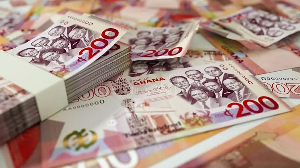 File photo of cedi note






Opinions