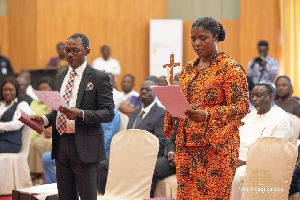
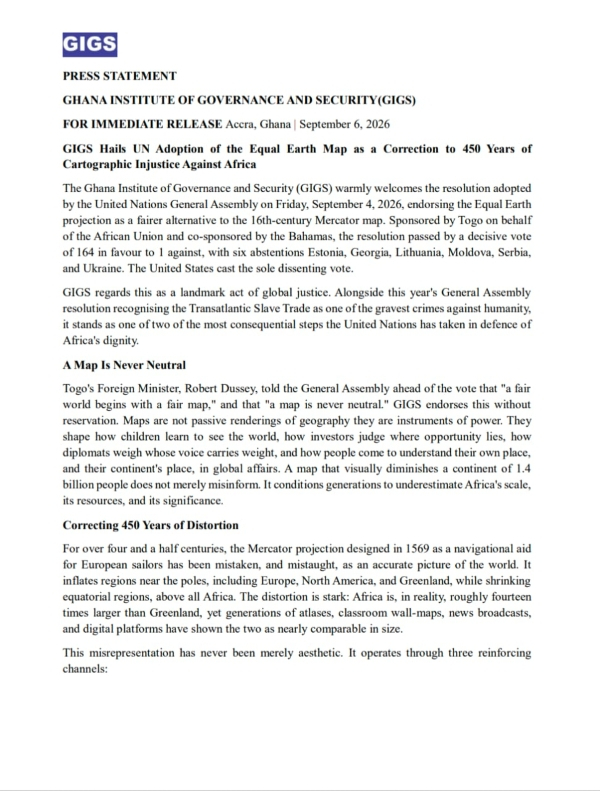
The Ghana Institute of Governance and Security (GIGS) has welcomed the United Nations General Assembly’s adoption of the Equal Earth projection, calling the move a significant step toward correcting what it describes as centuries of cartographic injustice against Africa.
The UN General Assembly on Friday, September 4, 2026, adopted a resolution endorsing the Equal Earth projection as a fairer alternative to the Mercator map, widely used since the 16th century.
UN votes to adopt new world map to reflect Africa's true size
According to GIGS, the resolution, sponsored by Togo on behalf of the African Union and co-sponsored by the Bahamas, was approved by 164 member states, with one country voting against and six abstaining.
The United States was the sole country to vote against the resolution, while Estonia, Georgia, Lithuania, Moldova, Serbia and Ukraine abstained.
In a statement issued on Sunday, September 6, 2026, GIGS described the development as a “landmark act of global justice” and one of the United Nations’ most consequential steps in defence of Africa’s dignity.
GIGS cited remarks by Togo’s Foreign Minister, Robert Dussey, who told the General Assembly ahead of the vote that “a fair world begins with a fair map” and “a map is never neutral.”
The Institute said it fully endorsed the position, arguing that maps influence how people perceive different parts of the world.
“Maps are not passive renderings of geography—they are instruments of power,” GIGS said.
It added that the widespread use of maps that visually reduce Africa’s size could influence how generations perceive the continent’s importance, resources and global standing.
“A map that visually diminishes a continent of 1.4 billion people does not merely misinform. It conditions generations to underestimate Africa’s scale, its resources, and its significance,” the statement said.
GIGS argued that the Mercator projection, designed in 1569 primarily as a navigational aid for European sailors, has for centuries been presented as an accurate representation of the world despite its distortions.
The Institute said the projection enlarges areas closer to the poles while reducing the apparent size of equatorial regions, particularly Africa.
It noted that Africa is “roughly fourteen times larger than Greenland” in reality, despite the two appearing nearly comparable in size on many traditional maps.
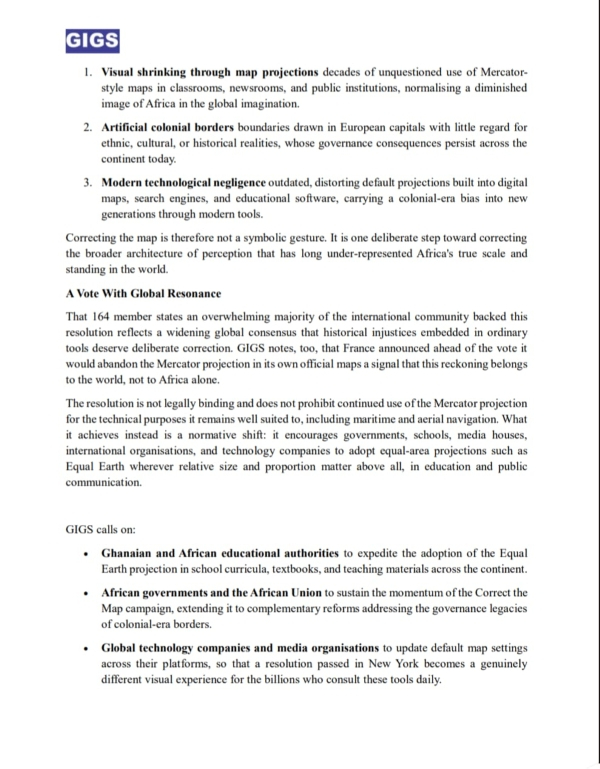
GIGS said the distortion has been reinforced through its continued use in classrooms, newsrooms, public institutions and digital platforms.
The organisation further linked the issue to the legacy of colonial borders and what it described as outdated map projections embedded in modern technologies.
“Correcting the map is therefore not a symbolic gesture,” GIGS said, arguing that the change represents “one deliberate step toward correcting the broader architecture of perception that has long under-represented Africa’s true scale and standing in the world.”
GIGS has called on Ghanaian and African educational authorities to accelerate the adoption of the Equal Earth projection in school curricula, textbooks and teaching materials.
It also urged African governments and the African Union to maintain the momentum of the “Correct the Map” campaign and extend it to reforms addressing the governance consequences of colonial-era borders.
The Institute further called on global technology companies and media organisations to update their default map settings so that equal-area projections are more widely used where relative size and proportion are important.
However, GIGS acknowledged that the UN resolution is not legally binding and does not prohibit the continued use of the Mercator projection for technical purposes, including maritime and aerial navigation.
Instead, it said the resolution represents a “normative shift” encouraging governments, schools, media organisations, international bodies and technology companies to adopt equal-area projections such as Equal Earth, particularly in education and public communication.
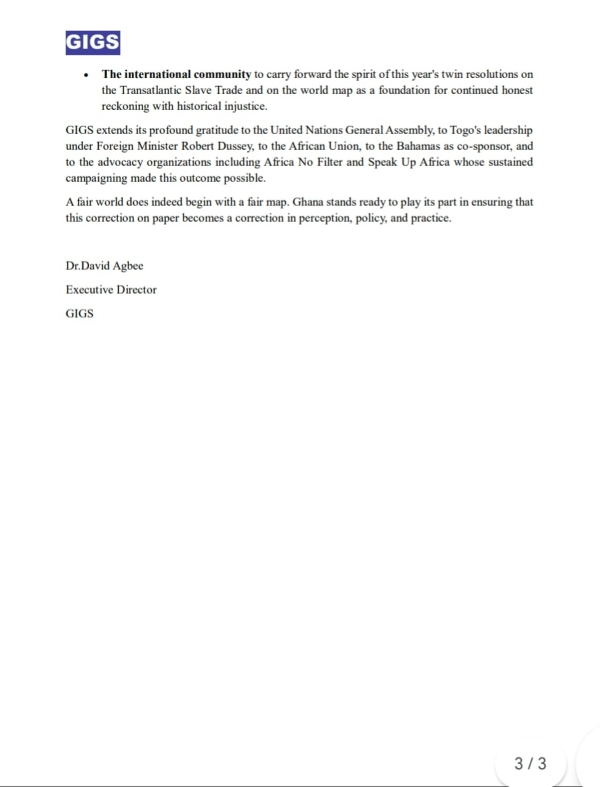
GIGS also commended Togo, the African Union, the Bahamas and advocacy organisations including Africa No Filter and Speak Up Africa for their roles in the campaign.
“A fair world does indeed begin with a fair map,” the Institute said, adding that “Ghana stands ready to play its part in ensuring that this correction on paper becomes a correction in perception, policy, and practice.”
Read the full statement below
NA/BAI
"Invest in Us Now!" — Hasaacas Ladies CEO Confronts VP Over Women’s Football
General News of Tuesday, 8 September 2026
Source: www.ghanaweb.com
GIGS welcomes UN adoption of Equal Earth map, calls for end to Africa’s ‘cartographic injustice’
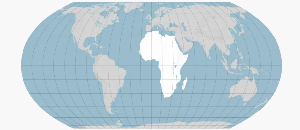 The Equal Earth projection presents size and shape more accurately


Entertainment