The Ghana Immigration Service (GIS) has arrested 1,055 people, including 662 children, as part of an operation targeting organised street begging and suspected human trafficking networks in the Greater Accra and Ashanti regions.
The operation, conducted in the early hours of Saturday, August 29, 2026, targeted criminal syndicates allegedly using organised begging as a cover to traffic and exploit vulnerable foreign nationals, particularly women and children.
According to the GIS, the operation covered major hotspots across Accra, including Abossey Okai, Sabon Zongo, Madina, Zongo Junction, Kasoa, Adabraka and Kwame Nkrumah Circle.
Ghanaian woman, others arrested as GIS busts network trafficking beggars into Ghana
The exercise also extended to areas in Kumasi, including Asafo, Asokwa Line, Sabo and Airport Junction.
The Service said its officers apprehended more than 1,000 West African nationals engaged in illicit activities, alongside several Ghanaians suspected of acting as local agents for the begging networks.
The GIS said the operation led to the arrest of 662 children, 145 men and 248 women, raising concerns about the vulnerability of minors within organised street-begging operations.
“The significant number of minors rescued highlights serious concerns regarding child vulnerability within exploitative systems,” the Service stated.
It added that the development reflects “a growing pattern of child trafficking for forced begging on Ghanaian streets.”
The operation also recorded a dramatic incident involving a Nigerian woman who was apprehended during the exercise. The woman reportedly complained of feeling unwell later in the day, prompting the GIS to deploy its medical team.
According to the Service, she was discovered to be in labour and was subsequently transferred to a nearby medical facility, where she delivered a baby girl.
“She remains under medical observation and is receiving appropriate care,” the GIS said.
The Service said all rescued individuals have been transferred to a designated holding centre for profiling and immigration processing in line with established procedures.
It said it is collaborating with the Ministry of Gender, Children and Social Protection and other relevant stakeholders to ensure that women, especially children, receive appropriate care, protection and support throughout the removal process.
The GIS said the latest operation forms part of previous enforcement actions and demonstrates its “sustained commitment” to combating human trafficking, upholding immigration laws and safeguarding the dignity and rights of people within Ghana.
The Service also expressed concern over the increasing incidence of migrant street begging, which it said contravenes provisions of the Beggars and Destitutes Act, 1969 (NLCD 392), and the Ghana Immigration Service Act, 2016 (Act 908).
“This issue has become a national dilemma and a recurring subject of high-level dialogues,” the statement said.
The GIS consequently appealed to Metropolitan, Municipal and District Chief Executives (MMDCEs) to support its efforts to clear the streets of migrant beggars.
The Comptroller-General of Immigration, Samuel Basintale Amadu, has also urged the public to refrain from giving alms directly to migrant beggars, particularly children.
The GIS explained that removing financial incentives would reduce the profitability of organised begging and discourage traffickers from exploiting vulnerable people on the streets.
“Removing financial incentives reduces the profitability of organised begging and discourages traffickers from exploiting vulnerable persons on the streets,” the statement said.
The Service instead encouraged individuals who wish to support vulnerable people to channel their donations through the Department of Social Welfare, recognised children’s homes, credible NGOs or other authorised charitable organisations.
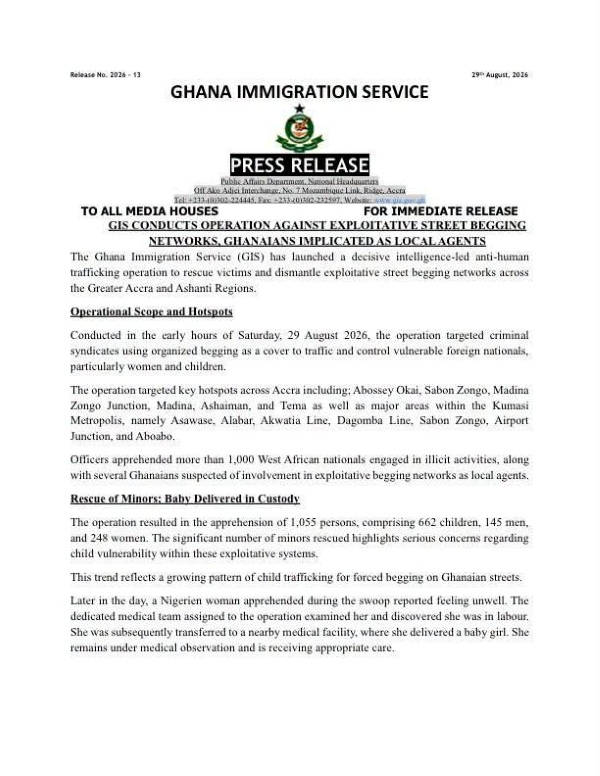
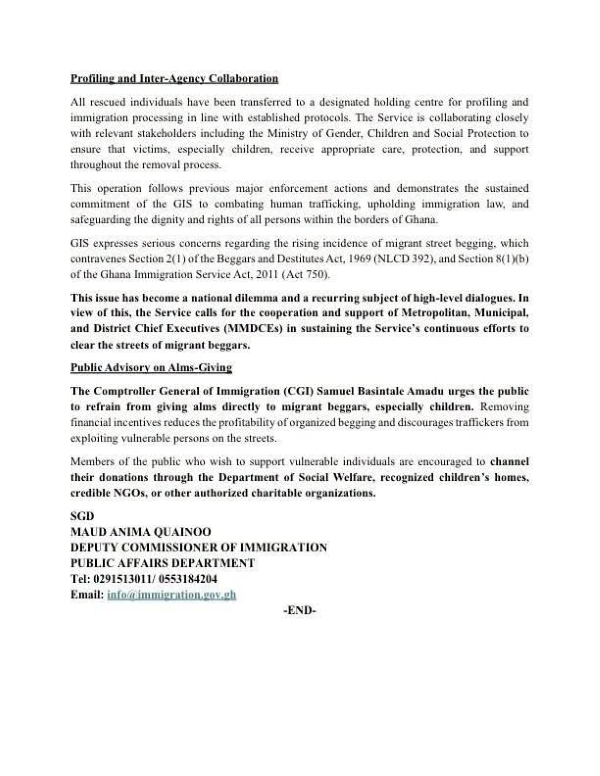
Read the full statement below
NA/AM
General News of Saturday, 5 September 2026
Source: www.ghanaweb.com
GIS arrests 1,055 in crackdown on migrant street begging networks
 GIS Logo



Entertainment