Ghana Cocoa Board (COCOBOD) is approaching its planned US$1 billion-equivalent domestic commercial-paper programme, scheduled to commence just a few weeks from now by releasing data that stands to encourage the portfolio investors it needs to attract, after a year and a half of worrying reports on its financial standing.
Indeed, financial reports released over the past fortnight suggest a substantially stronger standing than it could have presented even a year ago.
The combination of a return to profitability in 2025, a significant reduction in debt, restoration of positive equity and the settlement of outstanding obligations to investors is beginning to rebuild the institution’s credibility in Ghana’s capital market ahead of its forthcoming watershed commercial paper issuance.
The timing is important. In June 2026, Finance Minister Dr Cassiel Ato Forson announced that COCOBOD would replace its traditional offshore syndicated-loan model with a locally funded commercial-paper programme of about US$1 billion equivalent in cedis to finance purchases for the 2026/27 cocoa season. The programme is intended to provide working capital for cocoa purchases while reducing COCOBOD’s dependence on foreign-currency borrowing.
The most powerful improvement in the investment case is the financial turnaround recorded in 2025. According to management accounts submitted to the State Interests and Governance Authority (SIGA), COCOBOD generated operating revenue of GH¢48.62 billion in 2025, up a remarkable 207.7% from GH¢15.80 billion in 2024.
It moved from a net loss of GH¢5.73 billion in 2024 to a net profit of GH¢5.11 billion in 2025, these figures representing the absolute profit remaining after subtracting all financial burdens, including interest, administrative overheads, and other non-operating deductions from the total income.
Similarly its operating result – reflecting earnings from its core business activities – similarly swung from a GH¢4.07 billion loss to a GH¢6.17 billion profit.
The improvement was supported by a 33 percent increase in cocoa purchases, from 448,969 tonnes in 2024 to 597,377 tonnes in 2025. Cocoa-bean export revenue almost tripled, rising 194.2 percent from GH¢12.14 billion to GH¢35.70 billion, while domestic cocoa sales increased 252.3 percent, from GH¢3.67 billion to GH¢12.92 billion.
For portfolio investors, however, profitability is only part of the story. Perhaps more important is what happened to the balance sheet.
COCOBOD’s total equity moved from a negative GH¢3.65 billion in 2024 to positive equity of GH¢1.48 billion in 2025 — a turnaround of about GH¢5.13 billion. At the same time, interest-bearing debt fell by GH¢2.93 billion, or 19.2 percent, from GH¢15.23 billion to GH¢12.30 billion.
Total liabilities declined 12.7 percent, from GH¢32.67 billion to GH¢28.52 billion. Consequently, the debt-to-assets ratio improved from 1.13 times to 0.95 times.
The improvement in debt-service capacity is particularly relevant for prospective commercial-paper investors. COCOBOD’s interest-cover ratio improved from a deeply negative 2.16 times in 2024 to 5.05 times in 2025. Its cost-recovery ratio also increased from 89.3% to 112.5 percent. These indicators suggest that the Board was generating sufficient operating income to cover its costs and finance charges in 2025.
Nevertheless, investors will not overlook COCOBOD’s liquidity constraints. Its current ratio improved from 0.72 times to 0.80 times, while cash and cash equivalents increased 69.8% to GH¢1.11 billion. Yet the ratio remains below one, meaning short-term liabilities still exceeded current assets at the end of 2025. This makes the design of the new commercial-paper programme particularly important.
That design itself represents another improvement in the investment proposition. Under the model announced in June, the programme will be issued in three tranches: the first covering up to two months of purchases, the second an additional three months and the final tranche financing the remainder of the season.
Proceeds from cocoa sales are to flow through a dedicated escrow account from which investors will be repaid. The facility is intended to operate over the cocoa purchasing cycle and be retired before the next season’s programme is issued.
This is materially different from COCOBOD’s earlier financing problems, when dependence on large annual syndicated loans exposed the institution to refinancing risk.
By February 2026, COCOBOD acknowledged that its finances had deteriorated to the point where it lacked the liquidity needed to purchase cocoa, while the traditional syndicated-financing model had already experienced serious disruption.
The Board has also been actively repairing its relationship with investors whose funds were caught up in the 2023 restructuring. The second phase of Ghana’s Domestic Debt Exchange Programme included COCOBOD’s cocoa bills alongside domestic dollar-denominated debt and pension liabilities. In 2023, approximately GH¢7.93 billion of short-term Cocoa Bills were restructured into longer-term instruments.
COCOBOD has subsequently demonstrated a willingness to honour those restructured obligations. In March 2026 it paid GH¢376.3 million in coupons to DDEP-affected bondholders. On September 1, 2026, it made a further payment of GH¢2.306 billion, bringing total payments to DDEP bondholders during 2026 to GH¢2.683 billion and completing its mandatory obligations for the year.
Even investors who did not participate in the DDEP have now been dealt with. On July 15, 2026, COCOBOD paid GH¢162 million to individual Cocoa Bill holders who had opted out of the restructuring, bringing those outstanding obligations to an end.
This sequence matters enormously for the forthcoming commercial paper. An issuer seeking to raise the equivalent of US$1 billion from domestic investors needs more than a large underlying commodity business; it needs evidence that it can honour financial commitments.
COCOBOD can now point to a GH¢5.1 billion profit, positive equity, a GH¢2.93 billion reduction in interest-bearing debt and more than GH¢2.68 billion paid to DDEP bondholders in 2026, alongside the GH¢162 million settlement of non-DDEP Cocoa Bills.
There are still substantial risks. COCOBOD remains highly leveraged, its liquidity ratio remains below one and cocoa prices, production volumes, exchange rates and the ability to sell accumulated beans at profitable prices will determine its cash-generation capacity. Moreover, Reuters reported in February that licensed cocoa buyers owed Ghanaian banks an estimated GH¢7 billion–GH¢8 billion, underscoring the wider liquidity pressures still present in the cocoa value chain.
But the direction of travel is unmistakably positive. The forthcoming commercial-paper programme is therefore not merely another borrowing exercise. It is an early test of whether COCOBOD’s financial restructuring can translate into renewed confidence from Ghana’s pension funds, banks, asset managers and other portfolio investors.
If the programme is successfully subscribed at competitive pricing, it could become one of the clearest market validations yet that COCOBOD’s financial rehabilitation is moving from balance-sheet repair to genuine capital-market credibility.
Business News of Friday, 4 September 2026
Source: businesspostonline.com
COCOBOD targets US$1 billion after GH¢5.1 billion profit
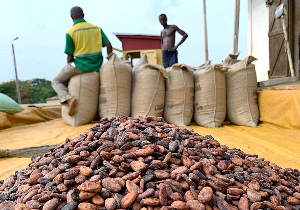 File photo of cocoa beans