The Managing Director of Cocoa Marketing Company (Ghana) Limited, Wisdom Kofi Dogbey, has called on international cocoa buyers, traders, processors and chocolate manufacturers to pay farmers a fairer share of the value generated along the global cocoa supply chain.
He said cocoa farmers, who bear the greatest risks and do the hard work of producing the crop, must receive better returns if Ghana and other producing countries are to sustainably rebuild cocoa production.
Dogbey made the call at the 4th Cocoa Association of Asia (CAA) International Cocoa Conference 2026, held in Singapore from September 1 to 3.
The conference brought together more than 600 industry leaders, producers, traders, policymakers and technology providers from more than 40 countries to discuss record-high cocoa prices, market volatility, supply chain challenges, the European Union Deforestation Regulation (EUDR), digital traceability, climate-smart agriculture and farmer livelihoods.
Dogbey said discussions about the future of cocoa should go beyond international prices and trading strategies to consider whether farmers have enough incentive to maintain, rehabilitate and replant their farms.
He argued that farmer income should be treated as a critical supply-security issue rather than simply a social concern.
“The cocoa farmer, who does the hard work of producing the crop, gets less than 10 per cent of the massive profits in the international value chain,” he said.
“Put the money back into the farm. Our adversary in this cycle is volatility, not each other.”
According to Dogbey, the current administration under President John Dramani Mahama has translated its policy of ensuring that cocoa farmers receive 70 per cent of the world market price into law through the newly enacted Ghana Cocoa Board Act, 2026.
The legislation, which was assented to on August 26, 2026, guarantees farmers at least 70 per cent of the Free on Board (FOB) value of cocoa and introduces other measures, including the Cocoa Farmers Pension Scheme, an educational trust for farmers’ children, protection of cocoa farmland and support for increased domestic processing.
Dogbey, however, stressed that statutory protection alone would not be enough if international buyers did not pay reasonable prices that enabled farmers to benefit meaningfully from their labour.
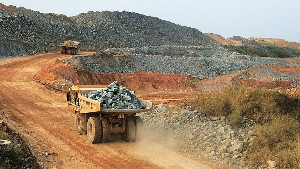
He said Ghana’s cocoa sector continued to face serious production challenges, including Cocoa Swollen Shoot Virus Disease, ageing farms, changing weather patterns, excessive rainfall, high input costs, mining encroachment and declining productivity.
The situation, he explained, was particularly difficult where diseased farms had to be completely removed, leaving farmers without income for several years while newly planted cocoa trees matured.
“The replanting rate is set by what the farmer expects to earn when the new tree bears, not by what the extension service recommends,” he said. “Farms go unreplanted when the return does not justify replanting. That is not a Ghanaian failing; it is arithmetic.”
He therefore urged international cocoa stakeholders to recognise that stronger farmer incomes were directly linked to future global cocoa supply.
If farmers lacked the financial incentive to rehabilitate and invest in their farms, he warned, production would decline, potentially leading to tighter supplies and increased price volatility across the industry.
Dogbey also called for existing mechanisms aimed at improving farmer incomes, particularly the Living Income Differential introduced by Ghana and Côte d’Ivoire, to be allowed to achieve their intended purpose.
“I am not asking for a new instrument. I am asking that the one already agreed be allowed to work,” he said.
He further appealed to international cocoa companies to share the financial burden of sustainability and traceability requirements.
Ghana, he noted, had invested significantly in farm mapping, geolocation and farmer registration to meet international due-diligence standards.
“If compliance is worth having, it is worth paying for,” he said, stressing that environmental sustainability could not be achieved without economic sustainability at the farm level.
Dogbey also encouraged international companies to invest directly in cocoa-producing countries instead of focusing only on sourcing cocoa.
“Diversification redistributes exposure. It does not create supply where the supply is at risk,” he said.
He urged international grinders, investors and equipment suppliers to “invest at origin, not only source from it”, noting that investments in farm rehabilitation, improved inputs, finance, new planting and irrigation would help strengthen Ghana’s cocoa production over the long term.
He said the call should not be viewed as a confrontation between producing and consuming countries but as an appeal for stronger partnership across the cocoa value chain.
“Invest at origin, not only source from it,” he urged.
Dogbey maintained that manufacturers, traders, governments, retailers and consumers all ultimately depended on farmers remaining willing and able to produce cocoa.
He said the future of the global cocoa industry therefore depended not only on recovering production but also on creating an economic environment in which cocoa farmers could earn enough to continue investing in their farms.
“There can be no sustainable global cocoa value chain without an economically sustainable cocoa farmer,” he stressed.
Business News of Thursday, 3 September 2026
Source: Desmond Tinana, Contributor
Pay fairer prices to cocoa farmers – CMC MD tells global cocoa industry
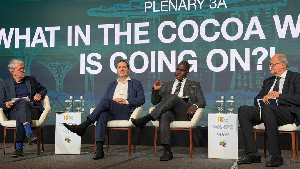 Dogbey made the call at the 4th Cocoa Association of Asia (CAA) International Cocoa Conference 2026