The Secretary General of the African Continental Free Trade Area (AfCFTA), Wamkele Mene, has urged African nations to dismantle inherited colonial economic structures and assert full economic sovereignty.
Speaking at the signing of a Joint Venture Agreement between the AfCFTA Secretariat and Quest Ghana on Monday, August 31, 2026, to establish a digital trade corridor, Mene said Africa cannot build a sustainable free trade future on outdated models.
“We must not be apologetic about dismantling the economic model that we inherited, which is colonialism. We must dismantle it fully,” Mene said.
He stressed that this shift does not mean withdrawing from the global economy, but rather ensuring Africa controls its own systems.
Mene identified cross-border payments as a critical area requiring reform, questioning why billions of dollars in intra-African trade transactions continue to pass through third currencies.
“We can no longer sustain third currencies receiving billions of dollars in transactions for intra-Africa trade,” he said.
He pointed to the Pan-African Payment and Settlement System (PAPSS) as a “continental payments highway” already connecting 150 commercial banks and 21 central banks.
The digital trade corridor, he added, will strengthen Africa’s integrated payments infrastructure and support economic transformation.
Mene called for billions of dollars in fresh investment in digital infrastructure, rejecting claims that the sector is overcrowded.
He argued that Africa’s digital transformation is vital for expanding participation among youth, SMEs, informal traders, and smallholder farmers.
Citing Africa’s success with mobile money and digital banking, he said the continent has already demonstrated innovation that rivals some developed economies.
He emphasized that Africa’s digital economy must retain more value within the continent by enabling transactions in African currencies.
With projections showing the digital economy could exceed US$710 billion by 2035, Mene insisted the target must be turned into reality through immediate action.
Mene called for billions of dollars in fresh investment in digital infrastructure, rejecting claims that the sector is overcrowded.
He argued that Africa’s digital transformation is vital for expanding participation among youth, SMEs, informal traders, and smallholder farmers.
Citing Africa’s success with mobile money and digital banking, he said the continent has already demonstrated innovation that rivals some developed economies.
He stated that Africa’s digital economy must retain more value within the continent by enabling transactions in African currencies.
With projections showing the digital economy could exceed US$710 billion by 2035, Mene insisted the target must be turned into reality through immediate action.
The AfCFTA chief described the partnership with Quest Ghana as evidence of a shift from policy formulation to practical implementation.
“We are moving from policy, from talk to action,” Mene said.
He called for stronger collaboration between governments, private-sector institutions, and investors to build an integrated African digital economy where SMEs, young entrepreneurs, and large corporations can thrive.
SA
Technology will be key to improving air traffic management – President Mahama
Business News of Tuesday, 1 September 2026
Source: www.ghanaweb.com
Africa must break colonial trade legacy - Wamkele Mene
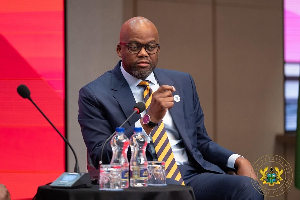 Wamkele Mene is the Secretary General of AfCFTA



Entertainment