The Bank of Ghana (BoG) is pushing for more companies to raise long-term financing through Ghana’s debt capital market as falling interest rates and the reopening of the domestic bond market create room for businesses to reduce their heavy reliance on bank credit.
Governor Dr Johnson Pandit Asiama said the central bank expects greater participation by corporate and quasi-government issuers as improving macroeconomic conditions restore confidence in fixed-income securities and widen financing options beyond government debt.
The push comes after government returned to the domestic bond market this year for the first time since 2022, reopening a segment that had effectively been closed to new long-term sovereign issuance following the Domestic Debt Exchange Programme (DDEP).
Government re-entered the market in March after the expiry of the three-year restriction imposed under the debt exchange, issuing a seven-year cedi-denominated bond which settled in April.
The return is helping rebuild the sovereign yield curve needed to provide pricing benchmarks for corporate bonds, infrastructure instruments and other forms of private debt.
Dr Asiama said government securities provide the benchmark against which corporate debt is priced, making the restoration of a credible yield curve important to the development of long-term private-sector financing.
The improvement in financing conditions has been supported by the sharp decline in interest rates following Ghana’s disinflation and monetary easing.
The 91-day Treasury bill rate, which exceeded 35 percent in early 2023, has fallen into single digits this year, while demand for government securities has strengthened with banks, pension funds, insurers and fund managers returning to the market.
Lower sovereign yields are important for companies seeking to issue debt because government securities generally establish the risk-free benchmark over which corporate issuers must pay a premium to compensate investors for additional credit and liquidity risks.
A sustained decline in the benchmark therefore creates greater scope for companies with strong balance sheets and predictable cash flows to issue longer-term debt at rates that could become increasingly competitive with conventional bank financing.
The Governor said government securities currently dominate Ghana’s debt capital market, but the BoG wants that concentration to decline as macroeconomic conditions improve and interest rates moderate.
“We would like to see a greater presence of private-sector issuers, through commercial papers and corporate bonds,” he said, adding that structural and regulatory constraints discouraging private-sector participation would have to be addressed to make market financing more accessible," he stated.
This would give Ghanaian companies another source of capital beyond commercial banks, which currently provide much of the financing for working capital and investment.
A deeper corporate debt market could allow companies to match long-term investments with longer-dated financing rather than funding expansion through shorter-term bank facilities that require refinancing more frequently.
It would also provide pension funds, insurers and other institutional investors with alternatives to government securities, potentially directing a greater share of long-term domestic savings towards corporate investment.
The recovery is already beginning to produce large prospective issuers.
COCOBOD has indicated that it intends to finance its operations for the 2026/27 cocoa season through commercial paper, targeting US$1 billion in three phases, according to the Governor.
Dr Asiama said the planned issuance demonstrated the growing potential of the Ghana Fixed Income Market as an alternative source of financing for businesses and other institutions.
The expansion of corporate issuance would mark a significant change from conditions following Ghana’s 2022 debt crisis, when rising yields, falling asset values and declining liquidity severely disrupted the domestic bond market.
During that period, investors shifted heavily towards shorter-dated Treasury bills to minimize interest-rate and duration risks, leaving the market concentrated at the short end and limiting long-term financing options.
Improved macroeconomic conditions are now beginning to reverse some of those pressures.
Inflation fell to 4.6% in July 2026, from a peak of 54.1% in December 2022, while the central bank expects inflation to remain within its medium-term target band of 8±2% through the remainder of this year.
The external position has also strengthened, with Ghana recording a trade surplus of about US$8.8 billion in the first half of 2026, while gross international reserves reached US$12.9 billion, equivalent to five months of import cover, at the end of June.
The stronger environment has widened participation in government securities to banks, pension funds, insurers, fund managers and other institutional investors, rebuilding the pool of capital that could also support private debt issuance.
For that liquidity to move more substantially into corporate financing, however, companies will have to offer instruments capable of competing with government securities for institutional funds while meeting stronger disclosure, credit and investor-protection requirements.
The BoG said work will therefore focus on removing structural and regulatory constraints to corporate issuance, improving market infrastructure and strengthening liquidity as the domestic debt market recovers.
A successful expansion beyond government securities would leave Ghana’s bond market playing a wider financing role, with companies able to tap pension, insurance and investment-fund capital directly for expansion instead of relying predominantly on bank balance sheets.
Business News of Tuesday, 1 September 2026
Source: economytimesnews.com
BoG urges companies to raise money through bonds
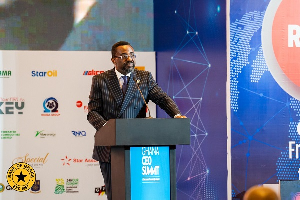 Dr Johnson Pandit Asiama is the Governor of BoG