A total of 206 communities across all 18 Municipal and District Assemblies in the Volta Region are expected to gain access to electricity under a newly launched GH¢598 million electrification project.
The Turnkey Electrification Project, being implemented under the Rural Electricity Acceleration and Urban Intensification Initiative (REIP), was launched by the Volta Regional Coordinating Council in collaboration with the Ministry of Energy and Green Transition at a sensitisation ceremony in Ho.
The project, which is expected to be completed within six months, forms part of the government’s broader efforts to achieve universal access to electricity and promote socio-economic development in underserved communities.
Launching the project, the Minister for Energy and Green Transition, Dr John Abdulai Jinapor, said the government had decided to mobilise domestic resources to finance the electrification programme rather than rely on external funding.
He said the first phase of the programme would cover the Volta, Oti, Central and Savannah regions, with the government targeting nationwide electricity coverage by 2030 or earlier.
Dr Jinapor said the Volta Region would receive additional attention because of persistent challenges with unstable power supply, low voltage levels and frequent outages.
He announced plans to construct a new 161-kilovolt transmission line from Asiekuma to Ho, as well as a 161/330/34.5-kilovolt bulk supply point in Ho.
According to him, the infrastructure would increase transmission capacity and facilitate the delivery of electricity from the Akosombo power enclave to Ho, thereby improving the stability and reliability of power supply in the region.
The Energy Minister said the transmission project was expected to improve voltage levels and reduce power interruptions, with completion targeted within the next 12 months.
He also disclosed plans to strengthen electricity supply along the Eastern Corridor, particularly the stretch from Kpando to Salaga. The intervention could involve constructing a new 330-kilovolt transmission line or expanding the existing 161-kilovolt network and adding bulk supply points.
To improve lighting in the regional capital, Dr Jinapor further announced plans to install solar-powered streetlights across Ho.
He said the government had also begun deploying 2,000 distribution transformers nationwide following an assessment that identified about 600 transformers as obsolete, damaged or no longer fit for use.
On concerns over alleged overbilling by the Electricity Company of Ghana (ECG), Dr Jinapor directed the Public Utilities Regulatory Commission (PURC) and the Energy Commission to conduct an independent investigation.
He said ECG could not be allowed to investigate allegations made against itself, stressing the need for an impartial and transparent process.
He assured consumers that customers found to have been wrongly billed or affected by faulty meters would receive the appropriate credits.
Dr Jinapor also acknowledged the contribution of the Agbogbomefia of Asogli State, Togbe Afede XIV, particularly his role in establishing and operating the Asogli Power Plant, which he said had contributed significantly to Ghana’s electricity supply.
The Energy Minister appealed to traditional authorities, assemblies and beneficiary communities to support the project by facilitating access to project sites, protecting project materials and helping to resolve right-of-way challenges.
He also urged residents to desist from vandalising electricity infrastructure and engaging in illegal connections, while encouraging consumers to pay their electricity bills and report suspected billing irregularities through the appropriate channels.
The main contractor for the electrification project is Byes and Ways Limited. The launch also included the formal handover of project sites to the contractor and briefings on arrangements for implementation, supervision and monitoring.
The Volta Regional Minister, James Gunu, said reliable electricity was critical to the development of the Volta Economic Corridor and the region’s efforts to attract investment and create jobs.
He said dependable power would help reduce production costs in agriculture and manufacturing, promote value addition, attract green investments and improve the region’s competitiveness.
Gunu described the Volta Region as one of Ghana’s promising investment destinations and said improved electricity supply would provide the foundation for transforming the regional economy from a resource-based economy into a value-added and export-oriented economy.
Speaking on behalf of the Volta Regional House of Chiefs, the Paramount Chief of the Kpando Traditional Area, Akpinifia Okpekpewuokpe Dagadu IX, expressed appreciation to the government for the intervention.
He appealed to the government to continue prioritising the Volta Region in the allocation of national development projects and resources, and pledged the support of traditional authorities for initiatives aimed at promoting development in the region.
Business News of Friday, 28 August 2026
Source: Desmond Tinana, Contributor
206 Volta communities to get electricity under GH¢598m project
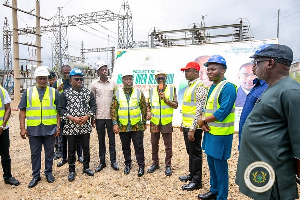 The project is expected to be completed within six months