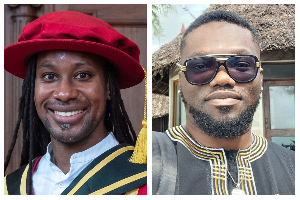
A Nigerian investigative journalist and researcher, David Hundeyin, has made a series of claims about the University of Cambridge following the death of British-born Ghanaian professor Jason Arday.
Arday, the British-born academic of Ghanaian heritage, died at the age of 41 after being found unresponsive at a property in Battersea, south London, on Friday, August 14.
His death came days after he resigned from Cambridge amid intense scrutiny over allegations of plagiarism and questions about aspects of his academic and personal history. He had denied plagiarism allegations, although he acknowledged errors in some of his earlier academic work. Police have said his death was unexpected but is not being treated as suspicious.
Following news of his death, Hundeyin took to social media on August 15,, 2026, to compare his own experience at the university to Arday's
“Cambridge is going to do exactly what it did to me 3 years ago,” Hundeyin wrote.
He accused the university of using what he described as “British silence” to distance itself from a controversy it had allegedly enabled.
He also claimed that the late academic was "cleared" off all allegations of plagiarism before he resigned
“Jason Arday was CLEARED of the plagiarism allegations by the way,” he wrote.
Hundeyin claimed that Arday's doctoral dissertation had been reviewed by Liverpool John Moores University (LJMU), where he obtained his PhD, and that the university found only a single sentence that had been misattributed in a thesis of about 146,000 words.
He argued that the issue was not that Arday had copied the sentence but that he had attributed it to a secondary source rather than the original source.
However, the wider controversy surrounding Arday went beyond that single claim.
Recent reporting raised questions about passages in his doctoral thesis, as well as claims relating to his academic background and achievements.
Cambridge initially defended Arday after an earlier investigation but subsequently launched a review of his appointment and tenure following renewed scrutiny.
Hundeyin's assertion that Arday was “cleared” should therefore be understood as his characterisation of the earlier review, rather than as a blanket finding that all subsequent concerns about Arday's academic record were dismissed.
Hundeyin also revisited an incident involving his own association with Cambridge in 2023.
He said the university failed to publicly support him when he faced allegations concerning comments made at a book launch.
Instead, he said Cambridge sent him a letter asking him to “use my affiliation sparingly” and work off-site where feasible.
The letter, dated February 14, 2023, was issued by the Management Committee of Cambridge's Centre of African Studies.
According to the letter, Hundeyin's academic visitor status would end as planned at the end of February, while he was asked to use the affiliation sparingly and work off-site where feasible.
a href="https://www.ghanaweb.com/GhanaHomePage/NewsArchive/6-things-to-know-about-the-British-born-Ghanaian-professor-who-died-at-41-2047840" target="_blank">6 things to know about the British-born Ghanaian professor who died at 41
Hundeyin said the letter was the reason he subsequently continued to identify himself as a 2023 James Currey Fellow at Cambridge.
“I’m doing the exact opposite of what they wanted, and I dare them to come out and say anything about it,” he wrote.
Hundeyin further suggested that Cambridge may have privately pressured Arday during the controversy.
“I’m willing to bet that was exactly what they did to Jason, and that was probably why he resigned,” he wrote.
He also speculated that someone within Arday's faculty may have been managing the situation privately and encouraging the professor to remain silent as criticism mounted.
There is, however, no publicly established evidence that Cambridge pressured Arday to resign or that such pressure caused his decision to leave the university.
Arday resigned on August 5, 2026, after describing the scrutiny surrounding him as an “unrelenting level of public scrutiny and personal attack”.
He said the experience had gone beyond normal academic disagreement and taken a profound toll on him and those close to him.
Hundeyin described Arday as a “vulnerable autistic Black man” and alleged that the scrutiny represented a form of racial targeting by the university.
He further claimed that the backlash against Arday reflected a broader pattern of what he described as racist behaviour in Britain.
Arday made history in 2023 when, aged 37, he became the university's youngest Black professor.
His appointment was widely seen as a significant milestone for racial representation in British academia.
See the post below:
Cambridge is going to do exactly what it did to me 3 years ago - use that supercilious, infuriatingly passive-aggressive British silence to distance itself from a public ritual lynching that it enabled and helped along.
— David Hundeyin (@DavidHundeyin) August 15, 2026
Jason Arday was CLEARED of the plagiarism allegations by… https://t.co/Itdcfni09N pic.twitter.com/DoCDnOAQDs
JKB/VPO
BizTech: Ghana’s STEM revolution and building the workforce of tomorrow