Auditors have reportedly uncovered blank Ghanaian biometric passport booklets and 59 used and unused visa stickers in the office of an IT officer at Ghana’s Embassy in Washington, DC.
According to pacgh.org on August 14, 2026, the materials were found in the office of Fred Kwarteng during a special audit of the embassy covering January 2017 to June 2025.
Ghana Embassy Scandal: How staff allegedly shared $19.4m from visa, passport applicants
The report indicated that 18 passport booklets were recovered from the office, and four of them were blank biometric passport booklets, with one bearing Kwarteng’s image. The auditors were also reported to have found active passport booklets which the Embassy could not account for.
The discovery is said to have raised questions about the handling of sensitive passport materials at the Mission, particularly because an earlier internal audit had already flagged weaknesses in the management of passport booklets.
Further details from pacgh.org added that a May 2021 internal audit found differences between the serial numbers of passport booklets supplied to the Embassy by Ridge PAC, Ghana’s biometric passport production partner, and the numbers recorded by the Mission.
It said that although the total number supplied matched the number recorded, the differences in serial numbers raised concerns.
The internal audit also found that the Embassy was holding more biometric passport booklets than it needed.
The audit recommended that the Mission introduce proper stock controls, including setting reorder levels based on usage and regularly reconciling passport inventories.
However, the latest audit found that the Embassy could not give a complete account of its passport stock management between 2016 and 2025.
Management was also unable to explain how blank passport booklets ended up in Kwarteng’s office or why the recommendations from the 2021 review had not been fully implemented.
The auditors also examined Kwarteng’s involvement in passport and visa application support services provided through a private company.
According to the audit, the private company’s website was linked to from the official website of Ghana’s Embassy in Washington DC.
The combination of the passport booklets and visa stickers found in his office and his involvement in the private services led the auditors to raise concerns about possible unauthorised passport and visa transactions.
The report said the circumstances “presuppose” that Kwarteng may have been involved in the fraudulent issuance of passports and visas outside the official Embassy process.
But a former Embassy staff member who spoke anonymously to Pledge Against Corruption offered a different explanation.
The source said Kwarteng frequently dealt with companies involved in printing Ghanaian passport booklets.
According to the source, some booklets had previously developed printing errors, including duplicated serial numbers, and became unusable after the errors were corrected.
The source suggested that some of those booklets could have remained in Kwarteng’s office.
Additionally, the report stated that a forensic examination of 15 empty passport booklets recovered from the office found that they were genuine Ghana passport stock.
The booklets are said to have contained security features such as Supreme Court watermarks, UV-responsive images of Parliament House, the Coat of Arms and the Fawohodie symbol.
They also contained micro-text bearing the words “Republic of Ghana”; however, seven of the 15 booklets had defects on their biodata pages, including missing polycarbonate overlay, missing thermochromic print and missing Optical Variable Ink (OVI).
The auditors also found irregular Machine-Readable Zone (MRZ) alignment and cancellation markings.
The audit also uncovered concerns over the handling of digital records in Kwarteng’s office in the sense that his assigned desktop computer was found without its internal Solid-State Drive (SSD), which stores files and other system information.
Other devices found in or linked to the office included six used SATA hard drives, Dell Latitude, MacBook Pro and Lenovo ThinkPad laptops, an iPad, Samsung and iPhone mobile phones and RAM modules.
The auditors are reported to have said that the missing SSD raised concerns that electronic records could have been removed before the inspection.
The condition of the office also drew attention as drawers and shelves were found opened, while documents, storage devices, cables and computer parts were scattered around the room.
The audit report said the state of the office and the dismantled computer components “strongly suggests” that the computer system had been tampered with before the auditors arrived.
It said removing the SSD meant auditors could not access potentially important files, emails and system logs.
The report therefore raised suspicion that the storage device may have been deliberately removed to prevent access to records relating to passport processing, visa applications and financial transactions.
The audit report said, “Examination of the office environment revealed signs of disruption and disorder consistent with a hurried removal of equipment and documents. Several drawers and shelves were found opened and disorganised, with documents, storage media, cables, and electronic components scattered across the workspace. The condition of the office, including dismantled computer components and removed storage hardware, strongly suggests that the computer system had been tampered with prior to the audit inspection.
Kofi Tonto, Janet Koranteng: The people fingered in AG's forensic report on US Embassy scandal
“Given that the SSD typically contains the operating system, user files, emails, and system logs, its removal effectively eliminates access to potentially critical electronic records. This raises a reasonable suspicion that the storage device was intentionally removed to prevent auditors from examining digital records that could provide evidence of unauthorised activities, including possible manipulation of passport records, visa processing data, or financial transactions.”
MAG/VPO
#TrendingGH: 'Revisit the case' - Netizens react to controversial court ruling
General News of Friday, 14 August 2026
Source: www.ghanaweb.com
Ghana Embassy US Saga: Blank passports, 59 visa stickers allegedly found in IT officer's office
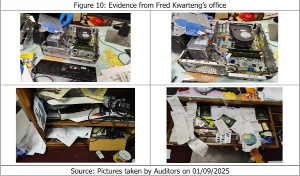 This picture was taken by auditors during a search of the IT officer's office