The Government of Ghana is redoubling its efforts to diversify the country’s export earnings away from an increasingly inordinate over-reliance on gold, following the warning from the International Monetary Fund (IMF) in its latest assessment of Ghana, released in last week, that the country’s macroeconomic recovery is being strengthened by gold, but at the same time is made increasingly vulnerable to it.
Ministry of Finance officials admit that the warning is made all the more worrying because it has come when gold is trading at US$4,313.95 per ounce which is about US$1,288.27 lower (roughly 23 percent down) than its all-time peak price of US$5,602.22 per ounce, which was achieved on January 28, 2026.
The IMF says gold accounted for more than 65 percent of Ghana’s merchandise exports in 2025 and is expected to account for an even larger share in 2026.
It cautions that a significant fall in international gold prices could quickly reduce export receipts, foreign-exchange inflows and fiscal resources.
The concentration is even more striking this year. Bank of Ghana data indicates that by July 2026 gold represented about 68.3 percent of total export earnings, compared with 12.5 percent for cocoa, 9.4 percent for crude oil and only 9.8 percent for non-traditional exports.
In the first half of 2026, total exports reached about US$18.2 billion, up from US$13.7 billion in the corresponding period of 2025. Gold alone generated approximately US$12.5 billion, compared with US$8.3 billion a year earlier.
Cocoa contributed about US$2.2 billion, while the overall trade surplus reached roughly US$8.8 billion.
That performance has helped rebuild Ghana’s external buffers. But it also demonstrates the magnitude of the diversification challenge: gold generated roughly two-thirds of export earnings in just six months, while every other export category combined generated about one-third.
Government’s diversification response
To be sure, government has not waited for the IMF warning before acknowledging the problem. Finance Minister Dr Cassiel Ato Forson has openly described gold concentration as a long-term economic risk, while arguing that Ghana must first maximize the benefits of the commodity boom and simultaneously build alternative sources of foreign exchange.
But it is instructive that government has indicated that diversification will be pursued over the medium term, rather than the short term, through measures that would not unnecessarily weaken the current improving external position.
The truth is that there are no short term solutions. Cocoa prices are volatile currently on international markets in 2026, peaking near US$6,455 per metric ton in early July after hitting a low of approximately US$3,241 per metric ton in mid-March, but currently trading at around US$5,724 per metric ton as the market balances improved West African port arrivals against lingering weather and crop disease concerns; all this following a sharp correction from 2024’s historic extremes of well over US$10,000 per ton.
Similarly, while Brent crude oil currently trades at approximately US$87.55 per barrel, its price hit a high of US$119.50 per barrel on March 9 this year amid an escalating Middle East conflict, up from a low of roughly US$64.50 per barrel at the start of January. But this is largely moot since Ghana is still a net importer of petroleum.
IMF upgrades Ghana’s debt distress risk rating to moderate
The Bank of Ghana is simultaneously trying to manage the risks created by gold concentration in the country’s reserves.
Governor Dr Johnson Pandit Asiama has defended the Bank’s decision to rebalance part of its gold holdings into foreign-exchange assets earlier this year, arguing that reserves must balance safety, liquidity, returns and diversification rather than become excessively concentrated in one asset.
Yet Asiama has also stressed the benefits of the current export boom. In early August he asserted that gold and cocoa exports had helped produce a stronger trade surplus and supported Ghana’s external resilience. Gross international reserves stood at approximately US$12.9 billion, equivalent to about five months of import cover at end-June.
That apparent contradiction captures Ghana’s policy predicament. Gold is currently solving some of the country’s external problems while potentially creating another.
The executive arm of government however is being forced by circumstances to look further down the road towards export diversification.
One of the most important vehicles is the 24-Hour Economy and Accelerated Export Development Programme, now backed by the 24-Hour Economy Authority Act, 2026. The programme seeks to transform Ghana from an import-dependent, low-value raw-material exporter into a production and export-oriented economy by expanding agriculture, manufacturing, agro-processing and related services.
The government’s Accelerated Export Development Advisory Committee has been mandated to coordinate government, private-sector and development-partner efforts around export barriers, investment and market access.
The export component has an explicit quantitative ambition. President John Mahama has set a target of increasing non-traditional export earnings from approximately US$3.5 billion annually to at least US$10 billion by 2030. Achieving that would almost triple non-traditional exports and, importantly, create a second major foreign-exchange engine outside minerals.
Government is also pursuing agricultural transformation through the Feed Ghana Programme and the broader Agriculture for Economic Transformation Agenda, alongside initiatives covering coconut, cashew and other commercial crops.
The objective is not merely to export more agricultural commodities but increasingly to process them domestically, retaining a larger share of the value chain.
Industrialization is consequently central to the strategy. Government-supported agro-processing plants covering products including yam, poultry, fish, cashew, rice, shea butter and palm-kernel oil, together with new cashew-processing facilities, are intended to convert agricultural production into exportable manufactured or semi-processed products.
Can diversification succeed?
The prospects are real, but the obstacles are formidable.
First is financing. Export-oriented agriculture, processing plants, industrial parks, logistics and reliable power require long-term capital, precisely when Ghana is emerging from a debt crisis and fiscal consolidation remains necessary.
Second is competitiveness. Producing a commodity domestically is not the same as producing it at a quality and cost capable of competing internationally.
Ghanaian exporters still confront expensive logistics, inadequate infrastructure, limited processing capacity, high energy costs, difficulties accessing affordable long-term finance and stringent international standards.
Third is policy consistency. Diversification requires investors to commit capital for years. Frequent changes in taxes, regulations, incentives and trade policies can undermine that confidence.
There is nevertheless an important reason for optimism. Governor Asiama says Ghana’s economy expanded by 6.4 percent in the first quarter of 2026, driven principally by services and industry, while private-sector credit growth exceeded 41 percent in June, compared with about 9% in 2025.
That suggests that the recovery is beginning to acquire a broader domestic-production base.
The government’s US$10 billion non-traditional-export target is therefore not impossible. But even if achieved, it would initially supplement rather than replace gold.
At US$10 billion, non-traditional exports would still be smaller than the US$12.5 billion gold earned in the first half of 2026 alone.
The strategic objective, consequently, is not to reduce gold production or earnings. It is to ensure that gold becomes Ghana’s strongest export pillar rather than its only major pillar.
The IMF’s warning is ultimately less a call to abandon gold than an injunction to use today’s gold windfall to finance tomorrow’s diversified economy.
Ghana’s success will depend on whether it can convert exceptional mineral revenues into productive investment in agriculture, manufacturing, services, technology and value-added exports before the commodity cycle turns.
The opportunity is considerable. The danger is that the country mistakes today’s gold-led prosperity for a permanently secure economic model.
Business News of Tuesday, 11 August 2026
Source: businesspostonline.com
Ghana moves to break gold’s grip on export earnings
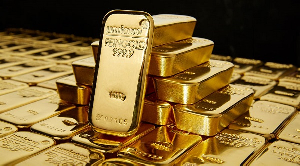 Bars of gold




Entertainment

Van Vicker 'slaps' LilWin with GH¢10m defamation suit

Opinions