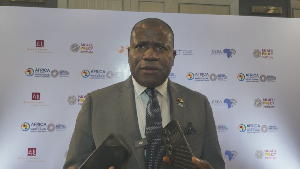
The Head of Cybersecurity Technology Standards at the Cyber Security Alliance (CSA), Jake France, has warned companies and their employees against using corporate names, acronyms and other identifiable information when conducting work-related searches on artificial intelligence (AI) platforms.
According to France, employees who enter their company’s names or specific project-related terms into AI tools risk exposing information that could later be aggregated and used to piece together details about their organisations’ activities.
“Please stop using your company name and acronyms in searches to do your work. Find a better way,” France cautioned.
Government exceeds T-Bill target by 73% as one-year yield nears 13%
He made the remarks during a panel discussion on JoyNews on Saturday, August 8, 2026, where he raised concerns about the ability of AI-powered search tools to aggregate information from different sources and deduce what organisations may be working on.
France said the risk becomes particularly significant when employees repeatedly use company-specific terms in their searches, as information entered by different people at different times can potentially contribute to a broader picture of an organisation's activities.
He recounted instances where his team tested the issue with companies whose officials had declined to disclose details of projects on the grounds that the information was private.
“We asked them what they were working on, and they said, ‘We’re working on this project,’ but when we asked for details, they said it was private,” he explained.
According to France, the team subsequently conducted online searches using only a few keywords associated with the projects.
“We just went online and typed in three keywords, and everything they were working on came up,” he said.
He attributed this to information that had previously been entered into online tools by individuals conducting research or completing work related to the projects.
“At some point, somebody had gone in there to do research to complete our work,” France said, warning that such seemingly harmless searches could contribute to the exposure of sensitive corporate information.
France also acknowledged that employees who have already used their company names or other identifying information in AI tools may feel that they have acted too late to prevent possible exposure.
“Exactly. We’re too late,” he said, while stressing the need for greater caution in future use of AI-powered tools.
He further suggested that once information has been submitted to an AI system, users should not assume that they can simply retrieve or erase it.
“You can’t get it back. You can’t delete it,” France said.
France said such an approach could potentially result in an AI system producing conflicting responses, although he acknowledged that the system could subsequently reflect the information it had received.
“If I ask it a question, it’s now going to give me the two responses and say, ‘For now, this is what I know,’ and you can make your decision going forward,” he said.
His comments highlight growing concerns about how employees use AI and online search tools in professional environments, particularly when handling information about confidential projects, internal operations and corporate strategy.
France urged organisations to adopt more cautious search practices and avoid entering information that could directly identify their companies or reveal sensitive aspects of their work.
ANAS/VPO
Ghana's recovery due to superior economic management - Ato Forson
Business News of Monday, 10 August 2026
Source: www.ghanaweb.com
Expert details how unguarded use of AI could expose critical company data
 A file photo of an AI



Entertainment