Minister of Energy and Green Transition, Dr John Abdulai Jinapor, has called for aggressive revenue collection across the power sector, particularly from state-owned institutions that are not exempt from paying electricity bills.
He contends that stronger collections are critical to improving the financial position of utilities such as the Bui Power Authority (BPA).
Speaking at the Bui Power Authority’s 2025 Annual Stakeholders’ Meeting, Dr. Jinapor said the burden of unpaid electricity bills was unfairly being shifted onto paying consumers and undermining the sector’s ability to invest in new generation capacity.
“You have ten people, six people are paying, four are not paying. It means that the six have to pay for the remaining four and so we have to be very aggressive when it comes to collection,” he said.
“Collection means that we are being fair to everybody, particularly state-owned institutions. So much as we want private consumers to pay, state-owned enterprises that have not been captured in the exemption list must provision and pay for that,” the minister added.
The minister argued that many public institutions find resources to purchase diesel during power outages but fail to settle their electricity bills when supplied with power.
“When the lights go off, these state-owned institutions get money to buy diesel. But when the lights are on and you want them to pay, they rather want only the private people to pay,” he stated.
Dr. John Abdullai Jinapor said improving revenue mobilization remains one of the government’s top priorities as it seeks to restore financial sustainability across the electricity value chain.
He noted that although Bui Power Authority posted a strong financial performance, including a profit of about US$62.2 million, its cash flow continues to be constrained by delayed payments from its off-taker, principally the Electricity Company of Ghana (ECG).
“Whilst you are seeing a good profit, you are also making provision for impairment and that creates a problem. It boils down to revenue collection by your off-taker, primarily ECG,” he said.
According to the minister, the Public Utilities Regulatory Commission (PURC) has been working with the ministry to improve collections, increase transparency and ensure a fairer distribution of revenues within the power sector.
“What we have to do to support you is that when you sell the power, you get your revenue, because you don’t control that aspect and for me, that is very key. As Minister, we have been working around the clock with the PURC. Last week, if you remember, we had a meeting with ECG to work on how they can improve that,” he said.
Dr John Abdulai Jinapor disclosed that ECG is introducing a new technology-driven meter reading system that will allow bills to be generated remotely and delivered directly to customers’ mobile phones.
This he said is part of efforts to improve revenue collection. According to him, ECG has begun recruiting young people who will use handheld devices capable of reading electricity meters without entering customers’ premises.
“ECG has come up with a new method. They are recruiting a lot of young people. They don’t need to enter your house now. Even if you sack them, don’t worry. Once they are close to your house, that machine will read the meter, and then you will get your bills,” he remarked.
Beyond revenue mobilisation, Dr Jinapor called on state-owned energy institutions to exercise greater spending discipline, arguing that improved collections alone would not solve the sector’s financial challenges if resources were not used efficiently.
“Even if we collect the money and we dissipate the money and use the money on frivolous expenditure, then we are going to have a problem,” he said, urging energy agencies to prioritise investments that improve operational performance.
The minister reiterated government’s commitment to restoring financial stability in the energy sector through reforms, including the cash waterfall mechanism and the Energy Sector Recovery Programme, while supporting Bui Power Authority to strengthen its commercial operations and expand its participation in the regional electricity market.
He noted that BPA’s revenue of about US$145 million and growing asset base demonstrate that the utility can become self-financing if revenue collection across the sector improves.
Dr John Abdulai Jinapor also criticized what he described as the practice of announcing electricity subsidies without making budgetary provisions to reimburse utilities.
He cited the previous government’s COVID-19 free electricity programme, saying payments were only made years after the policy was introduced.
“That money was only paid last year. From 2020, it sat on ECG’s books till 2025. I’m not against subsidy, but I’m saying that when you provide for that subsidy, pay for it as a government. If you cannot pay for it, tell the people and be honest,” he said, warning that unpaid subsidies ultimately become a burden on consumers.
The minister commended Bui Power Authority for exceeding its electricity generation target and expanding its renewable energy portfolio, including increasing its solar capacity from 55 megawatts to 105 megawatts and commissioning a battery energy storage system.
However, he urged the authority to prioritize battery-backed renewable energy projects to address Ghana’s evening peak demand.
“Our challenge is not daytime energy production or consumption. Our challenge is in the night,” he said, adding that expanding battery storage would allow excess daytime solar generation to be stored and dispatched during peak evening hours.
Business News of Monday, 10 August 2026
Source: radiogoldlive.com
Jinapor tells non-exempt SOEs to pay electricity bills
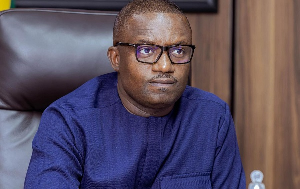 Minister of Energy and Green Transition, Dr John Abdulai Jinapor