The Project Manager of the Women and Youth Democratic Engagement (WYDE) Ghana Project at the Konrad-Adenauer-Stiftung (KAS) Ghana Office, Lawrencia Akosua Pomaa, has stressed the importance of investing in young political leaders early, saying the country’s future leadership depends on the values and skills they acquire today.
Speaking at the closing ceremony of the European Union Women and Youth Democratic Engagement (WYDE) Political Parties Project in Accra on August 6, 2026, Pomaa said many of Ghana’s current political leaders began their leadership journeys as student leaders and youth activists, making it important to equip emerging leaders with the right tools and values.
“Because if we look at the pattern five to 10 years from now, these are going to be the next leaders of our nation. People who have been SRC presidents, student leaders and youth political organisers are often the same people who eventually hold positions in Parliament and other high offices.
“What we wanted to do was catch them young and impart the values, tools and leadership skills they need so that when they get there, they know what they are doing,” she said.
The six-month initiative, implemented by the KAS Ghana Office in collaboration with the European Union and the European Network of Political Foundations (ENoP), sought to prepare emerging political leaders for public office through training, mentorship and dialogue on democratic governance, leadership and political communication.
Pomaa encouraged participants to maintain a culture of continuous learning even after the programme had ended.
“My advice for this cohort is to always be eager to learn and to keep learning. Learning never stops. Even as this project ends today, the learning process should continue,” she said.
Highlighting some of the programme's achievements, she noted that one of its greatest successes was bringing together young political leaders from different political traditions and helping them build lasting relationships beyond party affiliations.
According to her, participants drawn from youth political groups, including TEIN and TESCON, were able to engage one another constructively and establish friendships that could promote national development and political tolerance in the future.
Pomaa said the programme also strengthened participants’ understanding of leadership, communication and technical policy writing, including the preparation of policy briefs and proposals for parliamentary consideration.
She added that participants took part in a parliamentary simulation exercise that exposed them to legislative debate and helped them develop healthy debating skills and the ability to present sound arguments on national issues.
Also addressing the ceremony, Anna Wasserfall, Country Representative of the KAS Ghana Office, urged participants to uphold integrity, responsibility and accountability in their leadership journeys.
She said the true impact of the programme would be measured by the positive influence participants have in their communities and by the integrity they demonstrate in public life.
“It will be measured by the conversations that you are starting in your communities, by the young people that you encourage and by the integrity that you lead with when nobody else is watching,” she said.
Wasserfall added that democratic institutions become stronger when leaders consistently demonstrate honesty, resilience and accountability.
“If we have hundreds of committed young people making good leadership decisions every day, then something can actually change. That is how institutions become stronger, trust is built and democracies become more resilient,” she stated.
Jonas Claes, Deputy Head of Delegation and Head of the Political Section at the European Union Delegation to Ghana, reaffirmed the European Union’s commitment to supporting youth participation and democratic governance in Ghana.
“There are various engagements that we undertake, and we will continue to do so in the years ahead. Surely there will be continuity in our youth engagement here in Ghana,” he said.
Laurenz Van Ginneken, Project Manager at ENoP, encouraged participants to preserve the relationships formed during the programme and to prioritise national development above partisan interests.
“Democracy is a clash of ideas, not a clash of people,” he said.
The WYDE Political Parties Project forms part of the European Union’s broader Women and Youth Democratic Engagement programme, which seeks to strengthen leadership capacity, promote inclusive political dialogue and increase the participation of young people and women in democratic processes.
AM
#TrendingGH: 'Revisit the case' - Netizens react to controversial court ruling
General News of Friday, 7 August 2026
Source: www.ghanaweb.com
Investing in young political leaders is investing in Ghana’s future - Lawrencia Akosua Pomaa
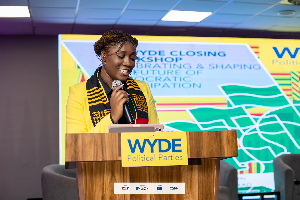 Project Manager of the WYDE Ghana Project at KAS, Lawrencia Akosua Pomaa


Entertainment
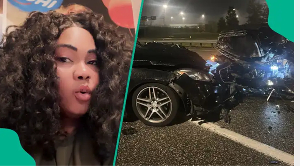
Singer Chichi survives ghastly Car accident in US

Opinions