The Government Statistician and Head of the Ghana Statistical Service (GSS), Dr Alhassan Iddrisu, has raised concerns over increasing bribery demands within Ghana’s public institutions, revealing that seven out of every 10 citizens who sought public services between July and December 2025 were asked to make informal payments.
Presenting findings from the third wave of the GSS Governance Series on Augustt 4, 2026, he disclosed that while the proportion of Ghanaians who actually paid bribes increased from 14.3% in the first half of 2025 to 18.0% in the second half, demands made directly by public officials surged to 69.4%.
“The pressure sits at the counter,” Dr Iddrisu said, stressing that demands from public officers, rather than offers from citizens, are driving the trend.
Global market cocoa prices surge
Despite the increase in bribery pressure during the latter half of the year, the report indicated an overall improvement compared to 2024. National bribe payments declined to 16.8%, while the proportion of high-value bribes exceeding GH¢1,000 dropped from 14.7% to 7.6%.
The survey also recorded growing resistance among citizens, with 4.9% refusing to comply with demands for bribes.
According to the report, law enforcement agencies remain among the public institutions with the highest incidence of bribery.
The Police Motor Traffic and Transport Department (MTTD) recorded the highest incidence of unofficial payments at 54.6%, followed by the Police General Duties Department (37.4%), the Criminal Investigation Department (29.5%), the Ghana Ports and Harbours Authority (26.2%), the Traffic Management Authority (City Guard) (24.8%), the Ghana Immigration Service (23.5%), the Births and Deaths Registry (20.3%), the Driver and Vehicle Licensing Authority (18.0%), the Passport Office (11.1%) and embassies and consulates (10.7%).
The GSS further found that cash accounted for 94.8% of all bribe payments, although the use of non-cash gifts, including property, doubled during the period.
Dr Iddrisu said addressing the growing extortion trend would require reducing face-to-face interactions between public officials and citizens through digital service delivery.
“The pressure sits at the counter,” he reiterated, adding that ending extortion requires “aggressive digitisation of service delivery to eliminate officer discretion, alongside stronger protection for citizens who resist corruption.”
ANAS/MA
Ghana's recovery due to superior economic management - Ato Forson
General News of Wednesday, 5 August 2026
Source: www.ghanaweb.com
7 in 10 Ghanaians asked for bribes when seeking public services - Report
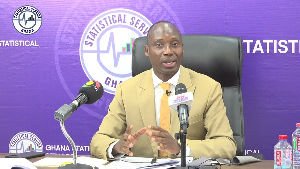 Dr Alhassan Iddrisu is the Head of the Ghana Statistical Service (GSS)