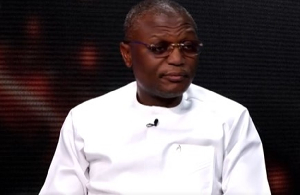
The former Director of the Institute of Statistical, Social and Economic Research (ISSER), Professor Peter Quartey, has described the government’s expenditure cuts in the first half of 2026 as “excessive”, warning that the pursuit of macroeconomic stability must not undermine critical development priorities.
He said while fiscal discipline was necessary to restore economic stability, reducing public spending by more than 20 per cent went beyond what could be considered prudent.
Speaking at ISSER’s review of the 2026 Mid-Year Budget Review and Economic Policy of the Government in Accra last Friday, Prof Quartey said a deviation of about five per cent from planned expenditure was acceptable, but the current 20.6 per cent reduction posed risks to investments in essential public services and infrastructure.
“When your roads are bad, when you have poor sanitation, when we are experiencing flooding and there are so many things that require funding, I think this kind of stability is excessive,” he said.
Prof Quartey compared the situation to a medical prescription, explaining that while a certain level of adjustment might be necessary, excessive measures could create new problems.
“It is just like going to the hospital and the doctor tells you to lose five kilos. You go back and you have lost 10 or 15 kilos. That’s exactly what we are doing. So let us ensure stability, but not excessive stability. Anything up to a five per cent deviation is acceptable,” he stated.
ECG cuts losses by 69%
Government expenditure on a commitment basis for the first half of 2026 stood at GH¢136.9 billion, against a target of GH¢172.5 billion, representing a shortfall of 20.6 per cent.
The reduction was mainly attributed to lower-than-expected debt service payments, delays in capital expenditure under the government’s “Big Push” projects, and revenue shortfalls from earmarked funds.
Capital expenditure recorded the sharpest decline, falling by 41 per cent from a target of GH¢36.6 billion to an outturn of GH¢21.7 billion. Interest payments were also 24 per cent below target, while grants to other government units declined by 16 per cent.
On the revenue side, however, total revenue and grants remained largely on track, recording GH¢124.8 billion against a target of GH¢126.1 billion, representing a marginal deviation of 1.03 per cent.
Oil and gas receipts recorded the biggest shortfall, missing the target by 31 per cent, while non-oil non-tax revenue fell by 11 per cent. Other revenue, however, exceeded its target by 56 per cent.
Prof Quartey also raised concerns about the financial burden created by some state-owned enterprises (SOEs), saying several continued to make losses despite receiving significant public support.
“There is a lot of waste in state-owned enterprises. Some are profitable, but many are running losses, yet we continue to pump so much into them. We can improve our revenue by looking seriously at property rates and reforming SOEs,” he said.
He further criticised inefficiencies in property rate collection, citing findings from the Auditor-General’s report.
“The Auditor-General’s report stated clearly that we spent double what we collected last year. We paid more to collect the property rates than the revenue we generated. That is certainly not the way to go,” he stated.
Also speaking at the review, an ISSER Research Fellow, Dr Kwame Adjei-Mantey, identified property rates and reforms in SOEs as key opportunities for increasing domestic revenue.
“Property rates are low-hanging fruits. There are a lot of high-value properties that we are not taxing,” he said.
Dr Adjei-Mantey called for reforms to improve property rate collection, including clearer institutional responsibilities and stronger capacity for local authorities to effectively mobilise revenue.
He said unlocking the full potential of property taxation could provide government with a more sustainable source of domestic revenue to support national development.
Business News of Tuesday, 4 August 2026
Source: ghanaiantimes.com.gh
Fiscal discipline must not hurt critical projects - Prof Quartey
 Prof Peter Quartey is the former Director of ISSER