There was a time when the Black Satellites were more than Ghana’s youth team.
When Ghana’s Under-20 side arrived at a tournament, there was an expectation that they would not only compete but challenge for the trophy.
They were the pride of a football-mad nation and one of Africa’s most reliable producers of young talent.
Today, that aura feels distant.
The latest evidence unfolded in Côte d’Ivoire, where the Black Satellites competed in the 2026 WAFU B U-20 Championship.
Ghana opened their campaign against arch-rivals Nigeria and were beaten 4-2.
They picked up two points from their remaining two games, failing to beat Burkina Faso and minnows Togo.
The result is not an isolated disappointment. It is another chapter in a story that has been developing for years.
The golden generation
Go back to 2009 and the contrast could hardly be greater.
Ghana became the first African country to win the FIFA U-20 World Cup, beating Brazil on penalties in the final in Egypt.
The team contained players such as Andre Ayew, Dominic Adiyiah, Emmanuel Agyemang-Badu, Samuel Inkoom and Jonathan Mensah, youngsters who would go on to make significant contributions at senior level.
That generation was not an accident.
Ghana had already established itself as a youth powerhouse, winning the U-20 Africa Cup of Nations in 1993, 1999 and 2009.
Twelve years after that historic World Cup triumph, the Black Satellites added a fourth continental title in 2021.
Ghana therefore entered the 2020s with four U-20 AFCON trophies and the distinction of being the only African nation to have won the U-20 World Cup.
When the conveyor belt began to slow
But the conveyor belt has gradually slowed.
In 2017, Ghana failed to qualify for the U-20 AFCON. In 2019, the Satellites were eliminated in the group stage.
Then came the most embarrassing setback.
In 2022, the defending African champions failed to qualify for the 2023 U-20 AFCON.
Coaches keep changing, but the problems remain
The coaching situation has hardly helped.
Abdul Karim Zito guided Ghana to the 2021 continental title, but he was replaced by Samuel Boadu in December 2022.
Boadu’s tenure ended after Ghana’s disappointing 2023 WAFU campaign, with the team failing to qualify for the U-20 AFCON.
Desmond Ofei subsequently took charge and guided Ghana back to the continental tournament, before Maxwell Konadu replaced him in 2025.
Four coaches in a relatively short period. Each has arrived with his own ideas, players and approach.
Flashes of the old Satellites
Ghana returned to the 2024 WAFU B tournament under Ofei and reached the final, losing 2-1 to Nigeria.
That qualification took the Satellites to the 2025 U-20 AFCON. Again, there were flashes of the old Ghana. They reached the quarter-finals but lost to hosts Egypt 4-5 on penalties.
The defeat meant Ghana missed the 2025 FIFA U-20 World Cup in Chile, because the semi-finalists were the teams that earned Africa’s four tickets.
Another warning sign in 2026
Now comes 2026.
The Black Satellites arrived in Côte d’Ivoire with another new coach, another group of players and another opportunity to show that the decline had been exaggerated.
Instead, the opening performance against Nigeria exposed familiar weaknesses.
Ghana conceded four goals, including three before half-time.
Konadu himself acknowledged that the high-pressing plan backfired and that defensive mistakes were costly.
The concern goes beyond tactics.
Where are the next stars?
For years, Ghana’s youth teams appeared to have an almost endless supply of players capable of forcing their way into the Black Stars.
The names rolled off the tongue: Andre Ayew, Adiyiah, Agyemang-Badu, Inkoom, Jonathan Mensah.
Even the more recent generation produced Jerry Afriyie, who emerged as the star of the 2024 WAFU tournament.
But the current group has yet to generate that same sense of anticipation. And that is perhaps the clearest measure of the decline.
A team without a clear pathway
The Black Satellites were once a bridge to the senior national team.
Now, too often, they seem to exist as a tournament team, assembled, coached, competing and then dismantled before another group starts the process again.
That is where the real problem lies.
The 2027 opportunity
There is also an uncomfortable irony surrounding what comes next. Ghana will host the 2027 U-20 Africa Cup of Nations.
CAF awarded the country the hosting rights in 2026, giving the Black Satellites an automatic place in the tournament.
But qualification is hardly the problem anymore.
The challenge is building a team worthy of the occasion. The country once watched the Black Satellites conquer
Africa and then conquer the world.
Now, after years of inconsistent results, coaching changes and a shrinking pool of obvious breakthrough stars, Ghana finds itself trying to rediscover what once came naturally.
The Black Satellites have not lost their history.
They have lost their fear factor. And with a home U-20 AFCON approaching, Ghana has a precious opportunity and a huge responsibility to find it again.
FKA/AM
Watch as court takes over Cheddar’s prime property on Osu Oxford street
No contradictions in Finance Minister's Mid-Year Budget presentation - Majority Leader
Afenyo-Markin responds to Finance Minister's 2026 Mid Year Budget Review presentation
Ghana's recovery due to superior economic management - Ato Forson
Majority, Minority chant 'Free Wontumi', 'Bring Ken Back' after 2026 mid year budget review
Sports News of Tuesday, 4 August 2026
Source: www.ghanaweb.com
From World Champions to WAFU Strugglers: The painful decline of the Black Satellites
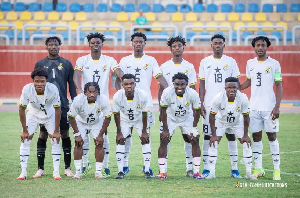 Black Satellites squad in a photograph after a football match