The Bank of Ghana has revealed that the cedi traded at GH¢11.6842 to the US dollar on the buying market and GH¢11.6958 on the selling market.
According to the exchange rates published on Monday, August 3, 2026, by the central bank, the British pound was quoted at GH¢15.7327 for buying and GH¢15.7496 for selling.
The latest exchange rates come amid assurances from the Bank of Ghana that the local currency has shown signs of recovery following earlier pressures in the foreign exchange market.
T-bills oversubscribed by 79% as one-year yield edges higher
Speaking at the 131st Monetary Policy Committee (MPC) press conference in Accra on Wednesday, July 22, 2026, Governor of the Bank of Ghana, Dr Johnson Asiama, disclosed that although the cedi faced significant demand pressures in May, conditions in the interbank foreign exchange market have since improved.
"In the interbank market, the cedi came under demand pressures in May but has since recovered. In the year to 17 July 2026, the cedi cumulatively depreciated by 9.5 percent against the US dollar," he stated.
The Governor also indicated that lending rates within the banking sector have eased considerably, supporting stronger credit growth to businesses.
"Average lending rates for the banking sector declined to 15.6 percent from 27.0 percent, reflecting improving financial conditions and easing borrowing costs," he said.
According to him, the reduction in lending rates has contributed to a sharp increase in private sector credit.
"In response to the eased cost of credit and stronger demand, private sector credit expanded by 41.2 percent in June 2026, compared with 8.6 percent during the same period in 2025," Dr Asiama noted.
He further described the banking sector as resilient, citing improvements in asset growth, solvency and loan quality.
"The banking sector recorded robust performance in June 2026, with strong asset growth, improved solvency, and enhanced asset quality," the BoG Governor said.
On fiscal developments, Dr Asiama explained that government spending remained largely restrained during the first quarter of the year despite revenue challenges.
"On a cash basis, fiscal performance in the first quarter broadly reflected strong expenditure restraint amid revenue shortfalls, resulting in better-than-targeted balances," he stated.
Touching on Ghana's external sector, the Governor said the country maintained a strong external position in the first half of 2026, supported by export earnings despite rising import costs.
"The external sector recorded a strong performance in the first half of 2026, bolstered by robust export earnings, despite a sharp rise in the import bill due to higher energy and related costs associated with the Middle East conflict," Dr Asiama added.
The Bank of Ghana continues to monitor developments in the foreign exchange market as part of efforts to sustain macroeconomic stability and support the cedi.
ANAS/BAI
Ghana's recovery due to superior economic management - Ato Forson
Business News of Monday, 3 August 2026
Source: www.ghanaweb.com
BoG cites improved interbank market conditions as cedi buy at GH¢11.6842
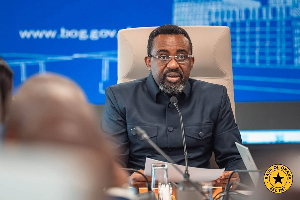 Dr. Johnson Pandit Asiama is the Governor of the Bank of Ghana.