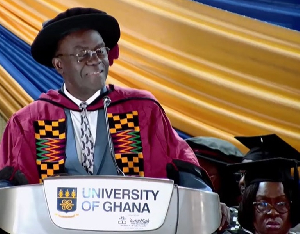
Professor Daniel Kwabena Twerefou, of the Department of Economics and Director of the Academic Quality Assurance Directorate at the University of Ghana, has called for proper management of natural resources else it spells doom for future generations.
He noted that environmental degradation has numerous repercussions, including reduced labour productivity and adverse effects on other aspects of human life.
Speaking at the inaugural lecture held at the UG Great Hall on July 30, 2026, on the topic “Ghana’s Stewardship Paradox: Rich in Resources, Poor in Governance,” the academic stressed the importance of safeguarding the environment.
Ghana loses US$54billion annually to environmental degradation – EPA
“Environmental degradation reduces utility directly through the loss of amenities and indirectly through illness, rising household expenditure, declining labour productivity, and reduced resilience. It also raises fundamental questions about intergenerational justice and sustainability.
“The concerns I have raised this evening can also be viewed through the lenses of Hartwick and Solow. Let me put it this way: Hartwick and Solow are among the well-known scholars in environmental economics, particularly in the area of natural resource accounting. Their central proposition is that sustainability does not require each generation to leave behind exactly the same stock of natural resources it inherited. Rather, what matters is that future generations inherit opportunities for welfare and development that are at least as great as those enjoyed by the current generation,” he said.
Prof Twerefou also emphasised the roles that society, institutions, and other stakeholders must play in promoting accountability to prevent environmental damage.
“The first is valuation. Society must recognise that forests, water bodies, fisheries, biodiversity, and air quality are forms of capital that generate welfare and productive services, even when markets ignore them.
“The second is institutional fit. Laws, agencies, and incentives must be aligned with the ecological characteristics of resources and the social realities of users.
“The third is accountability. Actors who generate environmental harm must face incentives that reflect the social costs they impose. When these three conditions are weak, de-environmentalisation becomes the default trajectory,” he added.
The professor called for stricter measures and policies to address environmental pollution.
He stressed that national development depends on a country’s ability to utilise its natural resources in ways that generate economic benefits for citizens.
“Ghana still possesses the intellectual resources, policy space, and social memory necessary to pursue re-environmentalisation. This would mean reintegrating traditional institutions into formal policy structures, strengthening natural capital accounting, pricing pollution more effectively, rewarding resource-conserving behaviour, supporting local stewardship institutions, building domestic value addition in extractive sectors, and treating ecological integrity as a core dimension of national welfare.
“If there is one lesson that emerges from this lecture, it is this: the real measure of development is not how quickly a nation converts forests, minerals, and rivers into economic growth, but whether it can steward these resources in ways that sustain prosperity across generations,” he noted.
Watch the lecture below:
SB/JE
Lawyer Maurice Ampaw on judicial corruption, national issues and Christian faith
Business News of Friday, 31 July 2026
Source: www.ghanaweb.com