The government has introduced a new 10-year urban development plan aimed at addressing Ghana’s growing challenges of flooding, housing shortages, congestion, and unplanned settlements.
The National Urban Policy (2026–2035) and the National Slum Upgrading and Prevention Strategy (2026–2035) were launched on July 28, 2026, during the opening of the 9th Ghana Urban Forum in Accra.
The policies are expected to guide the country's urban development agenda over the next decade, with a focus on improving city planning, promoting affordable housing, strengthening infrastructure, and building climate-resilient communities.
In a keynote address delivered on behalf of President John Dramani Mahama by the Board Chairman of the National Development Planning Commission (NDPC), Dr Nii Moi Thompson, the government acknowledged that Ghana’s previous National Urban Policy, introduced in 2012, achieved only about half of its intended objectives.
It noted that although the earlier policy recorded progress in areas such as urban safety, spatial planning, and environmental awareness, major gaps remained in affordable housing, urban financing, research, data systems, and coordination among institutions.
“As our towns and cities continue to grow, so must our resolve to ensure that urbanisation is managed in a manner that promotes inclusion, resilience, sustainability, and shared prosperity,” he stated.
President Mahama also highlighted the rapid pace of urbanisation in Ghana, noting that the country’s urban population has increased from about four million people in the 1980s to an estimated 20.4 million in 2026.
The new National Urban Policy is expected to promote sustainable urban growth through improved land-use planning, climate resilience, stronger infrastructure financing, digital governance and equitable access to basic services.
The accompanying National Slum Upgrading and Prevention Strategy is also aimed at improving conditions in informal settlements while preventing the development of new slums.
Speaking at the launch, Minister of Local Government, Chieftaincy, and Religious Affairs, Ahmed Ibrahim, urged Metropolitan, Municipal, and District Assemblies (MMDAs) to incorporate the new policy frameworks into their development plans and budgets.
He said the effectiveness of the policies would depend on implementation and measurable outcomes rather than the quality of the documents alone.
Ahmed Ibrahim assured that his ministry would coordinate the implementation, monitoring, and evaluation of both frameworks to ensure they deliver improvements in urban communities.
PHOTOS: The filth, wreckage and bodies left behind by the Accra floods
The government is hopeful that the two policy frameworks will help address Ghana’s urban challenges by improving city planning, reducing the growth of informal settlements, and creating more inclusive and sustainable cities by 2035.
JKB/VPO
Watch as court takes over Cheddar’s prime property on Osu Oxford street
General News of Wednesday, 29 July 2026
Source: www.ghanawweeb.com
From Floods to Housing Crisis: Inside Ghana’s new urban policy
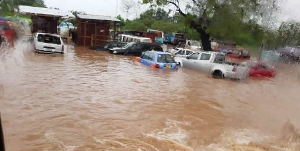 File photo of vehicles submerged in flood waters after heavy rainfall