Deputy Minister of Finance Thomas Nyarko Ampem has described the government's Commitment Authorisation policy as a "game changer" in strengthening fiscal discipline.
He revealed that requests to purchase vehicles worth GH¢1 billion were rejected under the policy's first year of implementation.
Speaking on the government's expenditure control measures, Ampem said the Commitment Authorisation framework had significantly improved oversight of public spending by ensuring that ministries, departments and agencies (MDAs) obtain approval from the Minister for Finance before committing the state to any financial obligation.
A&C Mall founder sacks long‑serving driver over fuel fraud
"If there is any policy that has helped us to instil discipline in this economy, in the management of our finances, and to have a handle on the economy, it is the introduction of the Commitment Authorisation," he said.
He explained that the policy was introduced after amendments were made to the Public Financial Management Regulations (PFMR), requiring all public institutions to secure Commitment Authorisation before entering into procurement contracts.
"Before you commit the state to any amount, you must come to the Finance Minister to give you Commitment Authorisation," Ampem stated, adding that the Finance Minister's assessment focuses on whether the proposed expenditure is budgeted for and whether funding is available.
According to the Deputy Minister, the reforms are also linked to a new fiscal responsibility requirement that obliges the government to maintain a 1.5 percent primary surplus on a commitment basis.
He also noted that failure by the Finance Minister to meet the target could attract parliamentary sanctions.
"If the Finance Minister fails to achieve this, he should be censured," Ampem said, adding that if he does not know what you are doing at your various MDAs, then he has to have a handle on it.
Highlighting the impact of the policy, Ampem disclosed that authorities turned down requests to acquire vehicles worth GH¢1 billion from MDAs, metropolitan, municipal and district assemblies (MMDAs), as well as state-owned enterprises (SOEs).
"In the first year, through the Commitment Authorisation process, we rejected the purchasing of cars to the tune of one billion cedis," he said, describing the decision as part of broader expenditure controls aimed at safeguarding public finances.
Ampem also criticised what he described as the inefficient use of donor-funded resources, particularly loans from the World Bank.
He said many public institutions had mistakenly viewed such financing as "free money", leading to spending on activities that did not directly contribute to economic growth. "For some reason, there was that impression that it was free money," he remarked. "If you look at the utilisation of some of these funds, you'll be sad."
The Deputy Minister said government had engaged the World Bank to redirect the use of loan resources towards infrastructure and other productive investments instead of recurrent expenditure.
"We are not comfortable that at this time, when we don't have access to the international bond market, the little resources we are having are being used for these soft things," he said. "We want to repurpose them. We want to draw down for specific infrastructure and other interventions that will help our economy grow," he added.
He disclosed that requests to use donor funds for conferences, foreign travel, vehicles and consultancy services were now being scrutinised more rigorously.
"When you bring requests to draw down, and we check the utilisation and we see any vehicle in it, we say no," Ampem stated.
He added that many MDAs were beginning to appreciate the rationale behind the tighter controls as government sought to prioritise value-for-money expenditure.
Ampem further revealed that the Presidency had also directed state institutions to scale back overseas training programmes for boards of state-owned enterprises, saying such activities had become excessive.
While reaffirming that funding would continue to be released for projects with strong economic impact, he stressed that government remained committed to enforcing prudent expenditure controls.
"As for releases to high-yielding impact projects and programmes, we are doing it," he said.
ANAS/EB
Ghana's recovery due to superior economic management - Ato Forson
Business News of Sunday, 26 July 2026
Source: www.ghanaweb.com
Commitment authorisation policy blocked GH¢1bn vehicle purchases - Deputy Finance Minister
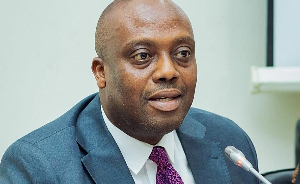 Thomas Nyarko Ampem is the Deputy Finance Minister