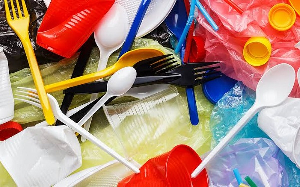
The Ghana Medical Association (GMA) has announced plans to petition the Minister of Environment, Science and Technology to support a broader ban on single-use plastics as part of efforts to address public health and environmental concerns.
President of the GMA, Professor Ernest Yorke, said on Friday, July 24, 2026, that the association believes expanding the proposed ban beyond Styrofoam food containers will help reduce plastic pollution, improve sanitation and contribute to addressing challenges such as flooding.
Speaking at the 26th Annual Public Lecture held at Capital View Hotel in Koforidua, organised by the GMA on the theme “Food Safety in Contemporary Ghana: Public Health Concerns for the Consumer,” Professor Yorke said the association would lead a petition to engage government on the need for stronger measures against single-use plastics.
Ban on styrofoam and single-use plastics key to tackling flooding - EPA
He expressed hope that the government’s planned ban on Styrofoam food containers would be fully implemented next year, while urging consideration of a wider restriction on other single-use plastic products.
“The GMA is going to lead a petition to the Honourable Minister of Environment, Science and Technology for the banning of single-use plastics. It is our hope that the intended ban of Styrofoam food containers will be carried through next year,” he said.
Professor Yorke noted that food safety was closely linked to environmental management, stressing that plastic waste contributes significantly to blocked drains and worsens the impact of flooding.
“Discarded plastic waste contributes substantially to blocked drains and waterways. During heavy rainfall, these obstructed drainage systems reduce the efficient flow of stormwater and can worsen flooding,” he said.
However, he acknowledged that flooding in Accra and other parts of the country is caused by multiple factors, including rapid urbanisation, inadequate drainage infrastructure, encroachment on waterways, weak enforcement of planning regulations and changing rainfall patterns.
He said addressing the plastic waste challenge must be accompanied by improved waste collection, recycling, public education and stronger enforcement of environmental regulations.
“The ban must be expanded to include single-use plastics in order to achieve a comprehensive solution,” Professor Yorke added.
The GMA President also emphasised that food safety requires collective responsibility among government, industry players, food vendors, farmers, consumers and healthcare professionals.
“Food safety is not solely the responsibility of regulators. It is not solely the responsibility of food vendors. It is not solely the responsibility of farmers. It is not solely the responsibility of consumers. It is a shared responsibility,” he said.
He stressed that adopting safe and environmentally sustainable food packaging practices would protect public health while supporting Ghana’s long-term development goals.
The public lecture brought together health professionals, policymakers, academics, students and other stakeholders to discuss food safety challenges, consumer choices, regulation and the role of environmental practices in protecting public health.
MA
Business News of Friday, 24 July 2026
Source: www.ghanaweb.com
GMA calls for expansion of Styrofoam ban to cover all single-use plastics
 GMA pushes for nationwide ban on single-use plastics over public health concern