For two decades, the Black Stars have carried Ghana's hopes onto football's biggest stage.
Since making their FIFA World Cup debut in Germany in 2006, Ghana have qualified for five World Cups: Germany 2006, South Africa 2010, Brazil 2014, Qatar 2022 and the expanded 2026 tournament in the United States, Canada and Mexico.
Each qualification has brought more than prestige. It has also delivered millions of dollars in FIFA prize money, qualification payments and tournament preparation funding.
Yet, almost 20 years after Ghana's first World Cup appearance, one question continues to echo through Ghanaian football:
What lasting legacy have those millions created?
Based on FIFA's published prize-money structures over the five tournaments, Ghana has earned at least US$55 million in performance prize money alone, excluding qualification payments, preparation grants, travel support and FIFA Forward development funding.
For many football nations, World Cup participation has become more than a tournament; it has become an opportunity to build for the future.
Perhaps no African country illustrates that better than Morocco.
In December 2019, the North Africans officially inaugurated the Mohammed VI Football Complex, a state-of-the-art national football centre built at an estimated cost of 630 million Moroccan dirhams.
The facility houses the men's, women's and youth national teams and includes multiple training pitches, accommodation, sports science laboratories, rehabilitation centres and performance analysis units.
Today, it stands as one of Africa's finest football facilities and has become a symbol of Morocco's long-term investment in football development.
Government spent GH¢68m on Black Stars’ World Cup campaign – Ato Forson
Senegal has followed a similar path.
In October 2022, they opened the Jules François Bocandé Technical Development Centre, constructed with support from FIFA Forward to strengthen elite player development and provide a permanent base for their national teams.
Ghana's principal football facility remains the Ghanaman Soccer Centre of Excellence at Prampram.
Commissioned in 2008 under FIFA's Goal Programme, the centre has received several upgrades in recent years through FIFA Forward funding, including renovated accommodation, improved pitches, floodlights and other infrastructure projects.
Yet despite those improvements, the Black Stars still do not permanently camp at Prampram before international assignments, often using hotels and different training venues depending on the occasion.
That contrast has fuelled debate among football followers over whether Ghana possesses a national football headquarters that truly reflects its status as a four-time African champion and five-time World Cup participant.
To be fair, the Ghana Football Association has undergone FIFA statutory audits and has publicly outlined projects financed through FIFA Forward, including infrastructure improvements, women's football, grassroots development, coach education and referee training.
The bigger question is one of legacy.
Should five World Cup appearances have produced a modern high-performance centre that serves as the permanent home of every Ghana national team?
Many Ghanaian football fans argue that qualification for the World Cup should leave behind more than memories and financial statements.
It should create assets that future generations can see, use and build upon.
As Ghana begins another four-year journey towards the 2030 FIFA World Cup, qualification will once again be the immediate objective.
But perhaps the greater ambition should be ensuring that every World Cup dollar leaves a permanent mark on Ghana football.
FKA/BAI
Sports News of Friday, 24 July 2026
Source: www.ghanaweb.com
Five World Cups, Millions Earned: Where did the money go?
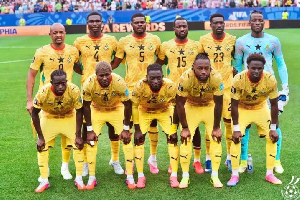 The Black Stars have made five World Cup appearances