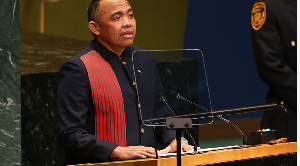
Chief Executive Officer of the National Petroleum Authority (NPA), Edudzi Kudzo Tameklo, has argued that the transfer of Ghanaian socialite Frederick Kumi, popularly known as Abu Trica, to the United States looks more like an rendition than a formal extradition.
Speaking on The Key Points on July 11, 2026, Tameklo questioned the speed with which the process was carried out, contending that extradition proceedings typically allow all legal avenues to be exhausted before a suspect is surrendered.
According to him, Abu Trica's lawyers had already secured a stay of execution before a competent court in Ghana, and the United States authorities should have waited for the judicial process to run its full course before taking him out of the country.
He argued that removing Abu Trica to stand trial in the United States while the stay of execution was still pending made the process appear more like a rendition than an extradition.
Addressing suggestions that the Ghanaian government may have reached an arrangement with the United States to facilitate Abu Trica's swift transfer, Tameklo said he was unaware of any such agreement.
He, however, suggested that the government may have opted not to resist the transfer to avoid any perception that it was shielding individuals accused of criminal conduct.
Inside Abu Trica's US Court Case: 20-year prison risk and trial date revealed
"As we speak today, there's a reason why Ken Ofori-Atta, for instance, is not in Ghana. The Government of Ghana wants him here to account for his stewardship, but the Americans believe there is a requirement for due process," he said.
"They have even gone further to give him a green card, permanent residency, notwithstanding the pendency of the extradition matter.
"So, my point is that, in terms of balancing competing interests, the extradition processes were legitimately ongoing in our courts. We could have done a balancing act by awaiting the outcome of the appellate review," he stated.
Tameklo maintained that allowing the appellate court to conclude its review, regardless of the eventual outcome, would have better upheld due process.
"In this case, it appears the process has been truncated. This one looks more like a rendition, in the sense that it is a removal to face trial," he stated.
He also dismissed claims that the transfer was the result of any quid pro quo arrangement between the governments of Ghana and the United States.
"I am not aware of any quid pro quo arrangements with the Government of the United States of America by way of laws or any other thing," he said.
Tameklo said he believed the government's decision was intended to demonstrate that it would not shield individuals implicated in organised crime.
"I strongly believe it is government's way of sending a message that there is zero tolerance for some of these offences and that there is no way the Government of Ghana is going to shield any person found to have engaged in such conduct or misdeed," he said.
Despite his concerns about the manner in which Abu Trica was transferred, Tameklo expressed confidence that the socialite would receive a fair trial in the United States.
"What is important is that where Abu Trica is going, the United States of America, is a country where there is great respect for due process and human rights, particularly anchored on a fair trial," he added.
General News of Monday, 13 July 2026
Source: www.ghanaweb.com
Abu Trica's transfer more like a rendition than an extradition - Edudzi Tameklo
 Edudzi Tameklo is the CEO of National Petroleum Authority (NPA)