Government spending fell short of its target in the first quarter of 2026, declining by 21.2% below projections, according to the Bank of Ghana’s May 2026 Monetary Policy Report.
Total expenditure and net lending for the period stood at GH¢62.089 billion, compared with the projected GH¢78.831 billion.
Wage payments accounted for the largest share of government expenditure. Compensation of Employees amounted to GH¢21.144 billion, missing the GH¢22.689 billion target by 6.8%, although it recorded an 18.1% increase compared with the same period in 2025.
Public sector wage payments accounted for 34.1% of domestic revenue collected during the quarter.
Spending on Goods and Services also fell below expectations. Government spent GH¢1.276 billion, which was 35.3% lower than the GH¢1.974 billion target. The Bank of Ghana interpreted the reduction as an indication that government was limiting discretionary spending.
Here's how much a private jet flight actually costs per hour in 2026
Despite missing the target, expenditure on Goods and Services was 153.5% higher than the amount spent during the same period in 2025.
Grants to other government units amounted to GH¢12.334 billion, falling short of the GH¢15.243 billion target by 19.1%, although the figure represented a 5.5% year-on-year increase.
Capital expenditure remained the biggest area of concern, with government spending GH¢7.345 billion on capital projects, equivalent to 0.5% of GDP. This was below the GH¢12.645 billion target (0.8% of GDP), representing a shortfall of 41.9%.
However, capital spending increased by 61.3% compared with the same period in 2025, suggesting some recovery in infrastructure investment despite remaining below projections.
Other expenditure totalled GH¢2.745 billion, 32.4% below its GH¢4.059 billion target but 12.3% higher than the amount recorded in the first quarter of 2025.
Interest payments amounted to GH¢17.243 billion, below the projected GH¢21.675 billion and 6.6% lower than the amount paid during the same quarter in 2025.
DR/MA
Inside the AI revolution that could save lives on Ghana's roads
Business News of Tuesday, 7 July 2026
Source: www.ghanaweb.com
Government spending falls 21% in Q1 2026 as capital projects miss target
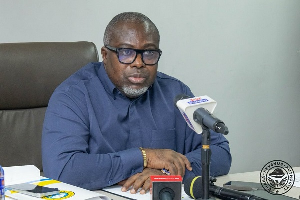
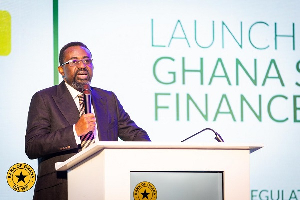 Dr Johnson Asiama is the BoG Governor


Entertainment