For most people, private aviation remains one of the great mysteries of air travel. Comparing economy, business, and first-class fares on a commercial flight takes about 30 seconds online.
Try finding out what a private charter actually costs, however, and you'll get ten different answers from ten different people, ranging from a few thousand dollars to six figures for a single trip.
In 2026, according to Simple Flying, hourly charter rates span a huge range. A small turboprop might cost around $2,000 an hour, while the largest ultra-long-range jets can exceed $20,000 an hour. However, the hourly rate is really just the starting point.
Taxes, fuel surcharges, positioning costs, airport fees, and seasonal demand all add to the final bill, often significantly increasing the total cost.
Understanding how these factors work together is the only way to determine whether a private flight is simply a luxury or a practical alternative to flying in a premium commercial cabin.
Private jet charter rates vary enormously by aircraft type
Aircraft choice is the single biggest factor affecting price. Much like the difference between a regional turboprop flight and an international first-class suite, charter costs vary widely depending on the aircraft's size, range, speed, and passenger capacity.
At the entry level is the turboprop, which remains the most affordable way to fly privately. Aircraft such as the Beechcraft King Air 350 are popular for shorter regional routes, offering comfortable space for a small group without the higher operating costs of a jet.
Pricing guides from Stratos Jets and Amalfi Jets estimate turboprop charter rates at around $2,000 per flight hour, although prices vary depending on the route and operator.
One step up are very light and light jets. The HondaJet, for example, typically seats four to eight passengers and cruises much faster than a turboprop while remaining more affordable than larger jets.
BlackJet and Amalfi Jets estimate hourly rates for these aircraft at between $2,500 and $4,500. This helps explain why they have become a popular choice for business travellers flying between major cities without the need for a larger aircraft.
For longer journeys, midsize and super-midsize jets take over. Aircraft such as the Cessna Citation Latitude and Bombardier Challenger 350 offer stand-up cabins, greater luggage capacity, and significantly longer range. These jets generally cost between $4,000 and $8,000 per hour, with operators often quoting around $6,500 per hour for popular super-midsize models.
At the top end of the market, heavy and ultra-long-range jets such as the Gulfstream G650ER typically command between $18,000 and $20,000 per flight hour.
Why the advertised hourly rate rarely matches the final invoice
Most people focus on the hourly rate quoted upfront, only to be surprised when the final invoice arrives. Charter pricing works much like airline pricing, the advertised rate rarely includes all of the additional costs.
Digital fraud, card disputes dominate banking complaints in 2025 – BoG
For example, the US Federal Excise Tax adds 7.5% to any domestic charter flight, according to BlackJet. On top of that, operators may charge segment fees, airport handling fees, crew overnight expenses, de-icing during winter, and fuel surcharges.
None of these costs are hidden, but they often do not appear in the initial quote. Together, they can add thousands of dollars to the total cost, particularly on longer or international flights.
Positioning costs are another common surprise. Unlike commercial airlines, charter aircraft do not operate on fixed schedules. The aircraft you book may be based hundreds of miles from your departure airport, and the cost of repositioning it is usually passed on to the customer.
That is why two similar trips can receive very different quotes, it often comes down to where the aircraft is located before your journey begins.
Why passenger count changes the private jet equation
One of the biggest mistakes people make when comparing private jets with commercial airlines is comparing the total charter cost to the price of a single airline ticket.
That is not how private charter works. When you charter a private jet, you are paying for the entire aircraft, and the total cost is shared among everyone on board. Viewed this way, the economics can look very different.
Turboprops such as the Pilatus PC-12 seat up to nine passengers and typically cost between $2,000 and $3,000 per hour. Light jets such as the Citation CJ3+ cost between $3,000 and $4,500 per hour for up to eight passengers.
Midsize jets like the Citation XLS+ generally range from $4,000 to $6,000 per hour, while super-midsize jets such as the Challenger 350 cost between $6,000 and $8,000 per hour.
Heavy jets, including the Gulfstream G450, typically cost between $8,000 and $15,000 per hour and can accommodate up to 14 passengers.
At the top end, ultra-long-range aircraft such as the Global 7500 operate intercontinental flights for $18,000 per hour or more.
Calculate the cost on a per-seat basis, and the picture changes quickly. Fill a turboprop with eight passengers on a short regional flight, and the per-person cost can approach that of a fully flexible business-class ticket.
Likewise, a group of executives travelling together on a super-midsize jet for a cross-country trip may pay roughly the same per person as they would for several last-minute premium airline tickets purchased individually.
When private jets actually rival first and business class
Private flying is not always ten times more expensive than commercial travel. The true cost depends on the route, distance, group size, and what type of airline ticket you are comparing it with.
For solo travellers, private jets are almost always more expensive than premium commercial cabins such as Delta One, Emirates First, or Singapore Suites.
However, when six to ten people share the cost of a turboprop, light jet, or midsize jet, the per-person price can be surprisingly close to premium commercial fares, especially during peak travel periods when tickets are purchased at the last minute.
Add the convenience of avoiding long security queues and eliminating connections, and the value proposition becomes much stronger.
There is no single price tag for private flying in 2026. The total cost depends on the aircraft, route, additional fees, market demand, and the number of passengers sharing the flight. For solo travellers, it remains a luxury. For groups, however, it can sometimes be the more practical and cost-effective option.
DR/MA
Inside the AI revolution that could save lives on Ghana's roads
Business News of Tuesday, 7 July 2026
Source: www.ghanaweb.com
Here's how much a private jet flight actually costs per hour in 2026
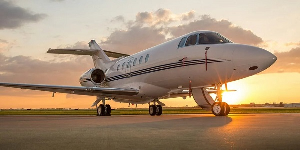 File photo of a private jet