The economy expanded by 6.4 percent in the first quarter of 2026, driven mainly by strong performances in the services and industrial sectors – particularly information and communication as well as mining and quarrying – according to provisional estimates from Ghana Statistical Service (GSS).
This growth rate represents a slight improvement over the 6.2 percent recorded in the same period of 2025, signalling continued economic momentum supported by rising domestic demand and investment activity.
Presenting the data in Accra, Government Statistician Dr Alhassan Iddrisu said the economy entered 2026 on a firm footing, underpinned by increased production and strengthening domestic demand.
GDP performance
Nominal Gross Domestic Product (GDP) rose from GH¢378billion in Q1-2025 to GH¢420.4billion in Q1-2026, representing an 11.2 percent increase. Real GDP also increased from GH¢53.9billion to GH¢57.4billion over the period.
Non-oil GDP expanded by 6.3 percent compared with 8 percent in the same quarter of 2025, indicating continued broad-based growth beyond the oil sector.
A key highlight of the quarter was a sharp decline in the GDP deflator, which fell from 23.9 percent in Q1-2025 to 4.1 percent in Q1-2026, reflecting easing inflationary pressures.
Dr Iddrisu noted that the combination of output growth and moderating prices points to improved macroeconomic stability.
Sector performance
The services sector remained the economy’s largest component, accounting for 45.7 percent of GDP and contributing 48.3 percent of total growth after expanding by 7.1 percent.
Industry grew by 6.9 percent, accounting for 32.9 percent of GDP and contributing 34.1 percent of growth, while agriculture expanded by 4 percent and contributed 13.5 percent.
National Petroleum Authority achieves triple ISO certification in historic first
Key growth drivers
Within services, information and communication was the fastest-growing activity, expanding by 25.2 percent and contributing 26.9 percent to total GDP growth.
“These results highlight the increasing importance of digital transformation, telecommunications, data services, technology platforms and digital connectivity in Ghana’s economic development,” Dr. Iddrisu said.
This was followed by transport and storage, which grew by 13 percent and contributed 12.1 percent, while trade and repair services rose by 9 percent and accounted for 14.8 percent of growth. Financial and insurance activities grew by 4.4 percent year-on-year.
Accommodation and food services contracted by 13.6 percent, with real estate and health and social work also recording declines.
In industry, growth was led by mining and quarrying which expanded by 10.7 percent and contributed 20.1 percent of total growth. Manufacturing and electricity both grew by 6.2 percent while construction expanded by 1.3 percent. Water and sewerage were the only industrial sub-sector to contract, declining by 3.7 percent.
The oil and gas sub-sector rebounded, growing by 7 percent after a contraction of 25.8 percent in the same period last year. Gold production rose by 15.7 percent, supporting industrial output and exports.
Agriculture performance
Agriculture grew by 4 percent, driven by crops and livestock which expanded by 4.7 percent and 5.7 percent respectively.
Forestry and logging recorded a strong rebound, growing by 9 percent after contracting by 2.5 percent a year earlier. However, fishing declined sharply by 18.5 percent – making it the weakest-performing subsector.
Growth concentration
Five activities – information and communication, mining and quarrying, trade and repair services, crops, and transport and storage – accounted for nearly 87 percent of total GDP growth.
Dr Iddrisu said this underscores the central role of digital services, mining, trade, agriculture and logistics in driving the economy.
Expenditure-side trends
On the expenditure side, gross domestic expenditure grew by 6.4 percent supported by strong domestic demand, which rose by 10.4 percent.
Household consumption increased by 7.5 percent while gross capital formation surged by 36.1 percent, reflecting a significant rise in investment activity.
Exports declined by 4.3 percent while imports increased by 11.3 percent over the period.
Dr Iddrisu said the surge in investment is a positive signal for future production and job creation.
Monthly economic activity (MIEG)
Seasonally adjusted quarter-on-quarter GDP growth stood at 1.6 percent, indicating sustained momentum from the final quarter of 2025.
The Monthly Indicator of Economic Growth (MIEG) showed steady expansion across the quarter, with growth of 6.1 percent in January, 7.7 percent in February and 5.4 percent in March.
Outlook
Dr Iddrisu said the data highlight strong opportunities in ICT, transport, mining, manufacturing and trade, while pointing to a need for policy attention in fishing, accommodation and food services and water and sewerage to ensure more balanced growth.
Business News of Thursday, 11 June 2026
Source: thebftonline.com
Economy grew 6.4% in Q1 2026 - GSS
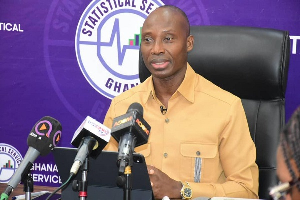 Dr Alhassan Iddrisu is the Government Statistician