A comprehensive audit of the 13th African Games, Accra 2023, has uncovered significant procurement irregularities within the Ghana Broadcasting Corporation (GBC), revealing how service providers were engaged without formal written contracts, service agreements, or other legally binding documents to back the arrangements, amounting to approximately GH¢3,560,213.52.
The 700-page audit report, conducted by the Ghana Audit Service, also examined GBC’s role as host broadcaster for the 13th African Games in 2023, which was marred by financial irregularities totalling GH¢580,042,347.40 (five hundred and eighty million, forty-two thousand, three hundred and forty-seven Ghana cedis, forty pesewas).
It cited pervasive overpricing, unqualified contractors, ghost equipment, and the systematic circumvention of procurement laws, implicating three former top officials.
The audit further estimated that GBC lost $4.96 million (approximately GH¢59.5 million) in potential revenue due to poor broadcast management and marketing of the Games, largely attributable to leadership failures in overseeing GBC’s role in the event.
The forensic audit commissioned by President John Dramani Mahama in 2025 into the African Games organised and hosted in Ghana in 2023 has revealed widespread cost inflation, irregular payments, and unsupported expenditure across contracts linked to the event.
The Auditor-General has since submitted the audit report to Parliament.
The findings indicate that despite being appointed through a formal agreement with the Ministry of Youth and Sports, GBC failed to execute proper contractual instruments when engaging third-party service providers.
However, the audit found that third-party engagements linked to that mandate were not supported by the contractual instruments required under public sector financial management and procurement rules.
According to the audit report, the lapses left key terms such as scope, deliverables, pricing, risk allocation, and dispute resolution undefined, raising procurement and accountability concerns.
The findings revealed that three major entities were identified as having provided services without documented agreements, including The Production Room (TPR), which was contracted for training GBC journalists and crew at a cost of €57,030.00, Silicon House Productions, which supplied two Out Broadcast Production Vans for $165,000.00 and Broadstem Co Ltd, which provided satellite services valued at $65,149.46.
Auditors noted that no signed contracts, service agreements, or legally binding instruments were made available to substantiate the terms, scope, deliverables, pricing, risk allocation, or dispute resolution mechanisms governing these engagements.
The audit further revealed that while GBC claimed to have requested the Public Procurement Authority’s ratification of these procurements on 12th August 2024, official records indicated the request was not formally received until 2nd September 2024, approximately five months after the games had concluded on 23rd March 2024.
The audit places the total financial exposure at about GH¢3,560,213.52, noting that no signed contracts or equivalent records were provided to substantiate the basis for selecting the entities or to demonstrate the obligations each party was meant to fulfil.
Auditors recommended that Professor Amin Alhassan, GBC’s Director-General, be sanctioned under Section 92 of the Public Procurement Act, 2003 (Act 663), as amended. The recommendation reflects the audit’s view that the corporation failed to follow required procurement controls in handling the broadcast work for the Games.
The absence of formal documentation left room for ex post justification rather than proper advance approval.
Delayed PPA ratification and procurement irregularities were found across its Games-related engagements. In what the audit described as a particularly irregular transaction, GBC paid €57,000 (approximately GH¢684,000) to The Production Room (TPR) under a training contract.
Audit interviews and document review found no evidence whatsoever of training delivery, no schedules, attendance records, training materials, or certification documents, and no proof that the engagement contributed anything to the Games broadcast. The contract was paid 100% in advance without competitive procurement, a needs assessment, or any deliverable-based safeguards.
The comprehensive report on the Audit Service website shows that a total of GH¢2,245,515,037.44 (Two billion, two hundred and forty-five million, five hundred and fifteen thousand, and thirty-seven Ghana cedis, forty-four pesewas) was received and spent on the Games, which were hosted in Ghana from March 8 to 23, 2024.
Despite this, the audit revealed an outstanding liability of GH¢208,583,739.49 as at the date of the report, comprising GH¢155,123,020.15, USD $4,118,155.65, and EUR 288,775.11.
The multi-sport event brought together all African nations (except Cape Verde) to compete for laurels across 29 sporting disciplines.
According to the audit report, total financial irregularities amounted to GH¢580,042,347.40, reflecting overpricing of doping tests, sports equipment, accommodation costs, vehicle-hiring contracts, vehicle brands, and high rental costs.
Other areas of irregularity identified in the audit report include overpayment for undelivered or unidentifiable sports equipment, unrelated LOC payments, irregularities in accounting for Games donations, and others.
The objectives of the audit were to assess the adequacy and effectiveness of financial and operational controls related to the Games, as well as compliance with procurement laws, financial regulations and contractual obligations.
It also aimed to evaluate the proper use of public and donor funds, assess the integrity of management and accreditation systems, and review post-Games handling of assets and facilities.
In addition, the audit verified the accuracy, completeness and authenticity of expenditures and assets procured for the event.
The comprehensive audit report has recommended the recovery of the irregular amounts from Mustapha Ussif, former Minister for Youth and Sports, William Kartey, former Chief Director of the Ministry and Dr Kwaku Ofosu-Asare, Local Organising Committee Chairman for the 13th African Games.
Aside the recommended recovery actions, it also demanded that the individuals are sanctioned across virtually every finding in the report in an effort to strengthen accountability and improve governance of future large-scale national events.
The report referenced AG.SAR/2026/03 and signed by Auditor-General Johnson Akuamoah-Asiedu, was carried out pursuant to Section 16 of the Audit Service Act, 2000 (Act 584) and a formal request from the Office of the President dated October 22, 2025.
Among the financial findings is the revelation that the Ministry of Sports paid GH¢38.9 million to Messrs Delovely Company Ltd under a sports equipment contract valued at $3.24 million, yet equipment worth $206,000 covering Table Tennis, Badminton and Handball was never supplied.
An additional lump-sum item of $408,000 labelled simply as “Sports Equipment” lacked any specifications or supporting documentation.
The audit determined that the revised payable contract value should have been $2.62 million, resulting in an overpayment of $374,000 (approximately GH¢4.5 million).
Anti-doping tests conducted by Omni Speciality Product Limited were procured at €739,000, but benchmarking against WADA-accredited laboratory rates revealed that unit prices significantly exceeded prevailing market rates.
The resulting price overcharge amounted to €572,000 (approximately GH¢8.0 million).
The audit also found that accommodation for Games officials was contracted through JDK Travel and Tours at $150 per room per night for 500 rooms over 21 days, totalling $1.58 million.
Market verification, however, showed that official hotel rates for the listed properties ranged from $50 to $70 per room, resulting in a justifiable total of approximately $735,000. The inflated component alone amounted to $840,000 (approximately GH¢10.1 million).
In a particularly glaring case, JDK Travel and Tours, registered as a travel and tour entity, was engaged to provide accommodation services despite having no accommodation licensing and operating merely as an intermediary.
Two of the hotels listed could not be independently verified. JDK was paid $1.58 million (approximately GH¢18.9 million) for these services.
The same entity also invoiced GH¢45.7 million under two vehicle transportation contracts: GH¢22.6 million for the main contract and GH¢23.1 million for additional services.
Benchmark comparison against market rental rates revealed significant inflation across vehicle categories and usage periods, with the total overpricing identified amounting to GH¢13.1 million. A further GH¢2.2 million was found to constitute a bloated invoice following an audit recomputation of actual quantities and usage frequencies.
JDK was also paid GH¢3.16 million for branding and de-branding of Games vehicles under a lump-sum contract.
Market benchmarking established that comparable services should have cost GH¢1.16 million, resulting in overpricing of GH¢2.0 million.
The audit uncovered a systemic flaw in the structure of 14 major service contracts: they were awarded at fixed, predetermined lump sums for services that were inherently variable in nature, services such as anti-doping tests (GH¢10.4m), accommodation (GH¢88.3m), catering (GH¢146.1m), air tickets (GH¢10.9m), and transportation (GH¢42.1m). The total value of these contracts was GH¢336.6 million. Contract files revealed no reconciliation controls, no rooming lists, meal registers, passenger manifests, transport logs, or test documentation to link payments to actual quantities delivered. The result: GH¢336.6 million was committed and paid without any verifiable alignment between contract sums and actual services consumed.
The pre-Games cost summary submitted by caterer L&M included non-feeding cost components totalling $2.83 million, broken down as Transport and Logistics ($87,000), Utilities ($542,000), Infrastructure and Equipment ($1.29 million), Staffing ($573,000), and Project Management and Administration ($339,000). These cost elements were embedded within the catering contract without supporting schedules, cost build-ups, or independent verification of necessity. The inclusion of these items, which clearly overlapped with services contracted to other providers, rendered the amount unjustified.
The audit identified what it described as “Common Beneficial Owner and Related-Party Exposure” amounting to GH¢150.6 million. Several companies that received contracts for the Games were found to share common ownership or beneficial control, raising concerns about undisclosed conflicts of interest and anti-competitive award practices in the procurement process.
Auditors flagged irregular and high-risk cash withdrawals amounting to GH¢20.4 million from the Local Organising Committee (LOC) accounts. Payments were made in cash to third parties in violation of mandatory Electronic Funds Transfer (EFT) requirements, and significant transactions were processed outside Ghana’s Integrated Financial Management Information System (GIFMIS), circumventing its financial controls. The LOC’s accounts were also found to have been used to make payments totalling GH¢15.1 million for activities entirely unrelated to the hosting of the 13th African Games, including advance salary payments and other disbursements to officials and staff of the Black Stars national football team, including the Head Coach and Assistant Coach.
Physical inspections of the five major Games infrastructure projects revealed widespread construction defects, including cold joints in concrete, slab cracking, poor compaction, inadequate waterproofing, corrosion of fittings, unsealed penetrations, drainage failures, and incomplete works at facilities such as the Aquatic Centre, Legon Stadium, temporary kitchen facilities, and Achimota Pavilion. Post-construction assessments further revealed progressive cracking, material degradation, and latent defects attributable to workmanship deficiencies, poor detailing, inadequate supervision, and insufficient quality assurance during execution. The cumulative rectification requirement is estimated at not less than $1.0 million (approximately GH¢12.0 million).
At the flagship Borteyman Sports Complex, an engineering analysis of the variation order dubbed the “May Action Plan” found that works omitted from the original scope amounted to $49.3 million while additions totalled only $14.9 million, resulting in a net loss of $34.4 million (23.8% of the contract value) that was absorbed to settle claims for time extensions, tax reimbursements, and delayed invoices. At the University of Ghana Stadium, five variations increased the contract from $34.1 million to $37.0 million, with auditors identifying avoidable and irregular claims totalling $2.8 million, including interest on delayed payments and prolongation costs approved outside standard EPC risk allocation.
One of the most alarming structural findings in the report concerns the near-total absence of competitive procurement. Single-source procurement contracts worth approximately GH¢2.7 billion were awarded without any documented justification, as required by law. Separate from this, the PPA itself is noted to have “reluctantly accepted” single-source contracts worth GH¢18.0 million and to have imposed a mandatory 10% (and in some cases 5%) reduction on contract sums totalling GH¢16.6 million, indicating that the Authority itself had concerns about the reasonableness of the costs submitted.
General News of Monday, 1 June 2026
Source: theheraldghana.com
Ghana Broadcasting Corporation implicated in GH¢580 million All African Games rot
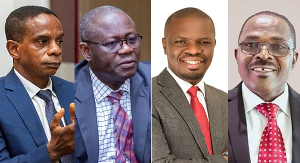 From Left - Johnson Akuamoah Asiedu, Prof Amin Alhassan, Mustapha Ussif, Dr Kwaku Ofosu-Asare



Entertainment