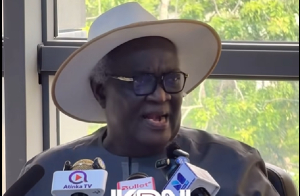
Former Minister of Local Government and Decentralisation, Professor Kwamena Ahwoi, has cautioned that poor implementation of decentralisation policies could threaten Ghana’s national unity and potentially fuel separatist tendencies.
Speaking at a sensitisation and policy orientation workshop organised by the Inter-Ministerial Coordinating Committee on Decentralisation (IMCC) on May 19, 2026, Professor Ahwoi said decentralisation, if not carefully managed, could evolve into federalism, secession and ultimately the disintegration of a state.
Professor Ahwoi, who also serves as Chairman of the IMCC Technical Committee, explained that Ghana’s decentralisation structure intentionally maintains weak regional authorities to preserve national cohesion.
“In decentralising, you must be aware that there are separatist tendencies. It is very easy to move from decentralisation to separation, to federalism, to balkanisation, to secession, and to the breakdown of the country,” he stated.
He described Ghana as an “artificial colonial construct,” arguing that, like many African states, the country was created through colonial arrangements rather than historical national unity.
According to him, the Ashanti Kingdom could historically have expanded to dominate much of present-day Ghana if not for British colonial intervention.
“It is most likely that Ashanti would have conquered the rest of Ghana. They had, because the British just stopped them,” he said.
Professor Ahwoi noted that Ghana has so far remained stable because of what he described as “wise Ashanti leaders” who have not promoted separatist agendas. However, he warned that ethnic or regional tensions could emerge if decentralisation structures are abused.
Sophia Akuffo enstooled as Akuapem Mmrahene despite opposition
He cited the former Soviet Union and Yugoslavia as examples of states that broke apart after internal divisions intensified. He also referenced Nigeria’s civil war following the attempted secession of Biafra under Lieutenant Colonel Chukwuemeka Odumegwu Ojukwu in the late 1960s.
According to him, Nigeria’s experience demonstrated how strong regional identities, combined with political leadership and resource control, could threaten national unity and lead to violent conflict.
Professor Ahwoi stressed that while decentralisation remains important for governance and local development, Ghana must avoid creating systems that could encourage fragmentation.
“I have explained to you that Ashanti could easily be a country. The Dagomba Kingdom could easily be a country. We don’t want to fashion out a governance system that will give an excuse for Ghana to break up,” he said.
The workshop formed part of efforts to build public awareness and support for Ghana’s new National Decentralisation Policy and Strategic Framework (2026–2030), with media practitioners participating in discussions on governance and local administration reforms.
TWI NEWS
AM
Nigeria's Nnamdi Onwaez thrilled after reaching 110m hurdles final
Esther Obenewaa targets Commonwealth Games gold medal glory
General News of Friday, 22 May 2026
Source: www.ghanaweb.com
Ashantis can easily take over Ghana to form their own country - Prof Ahwoi


Business
'No two-phone law' – GRA reiterates
Entertainment