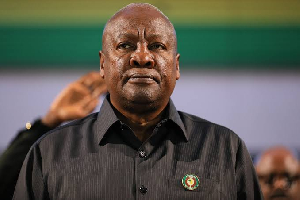
The Governor of the Bank of Ghana, Dr Johnson Pandit Asiama, has defended the decision by the Monetary Policy Committee (MPC) to maintain the policy rate at 14 percent, insisting that lingering geopolitical tensions in the Middle East continue to pose serious risks to Ghana’s inflation outlook and economic stability.
Responding to questions from journalists during the 130th MPC press briefing in Accra on Wednesday, Dr Asiama described the ongoing Middle East conflict as the “elephant in the room” influencing the central bank’s cautious policy stance.
According to him, although current economic indicators suggest there is room for further monetary easing, the MPC decided to pause and monitor developments because of uncertainties surrounding the global crisis.
“The committee evaluated other forms of risks. The elephant in the room here is the Middle East crisis,” the Governor stated. “Up to this time, one is not sure whether it is temporary or whether it is going to be long-lasting. If we assume that it will be longer-lasting, then you can imagine the impact on inflation expectations and the so-called second-round effects,” he added.
Dr Asiama explained that while real interest rate trends indicated possible room for further rate cuts, the MPC considered both domestic improvements and external shocks before arriving at its decision.
“That is why, in the wisdom of the committee, it was decided to pause and evaluate all incoming data so that at the next MPC round, the committee would take an appropriate decision,” he added.
The Governor also responded to concerns about the slow reduction in commercial bank lending rates despite falling benchmark interest rates. He explained that the current low-interest-rate regime remains relatively new to banks, forcing them to gradually adjust their portfolios and lending strategies.
“When interest rates are falling, it may take a while. You don’t just rush into giving loans. There have to be adequate bankable projects, and you don’t compromise your credit appraisal standards,” he said.
According to him, banks are acting cautiously to avoid excessive credit risks but lending rates are expected to adjust downward once the low-interest-rate environment is sustained.
Dr Asiama further justified the MPC’s additional policy measure to revise the dynamic cash reserve ratio to a uniform 20 percent reserve requirement in domestic currency, effective June 4, 2026.
He explained that the decision followed a review of earlier liquidity management measures introduced about a year ago.
“In the wisdom of the committee, we think this will go a long way to complement our open market operations,” he noted.
The Governor disclosed that the central bank would meet Chief Executive Officers of commercial banks next week to explain the implications of the new policy measures.
On the recent oversubscription of Treasury bill auctions, Dr Asiama declined to comment directly on government borrowing strategies, saying such matters are best addressed by the Ministry of Finance.
“You know it’s a market; it’s an auction. The banks and treasuries make those decisions based on market conditions and what they forecast going forward,” he said.
Addressing concerns about the depreciation of the cedi, the Governor stressed that Ghana operates a managed floating exchange rate regime and not a fixed exchange rate system.
“The cedi is expected to move. It can depreciate or appreciate. Our concern is to avoid excessive volatility,” he stated.
Dr Asiama attributed recent depreciation pressures mainly to increased foreign exchange demand arising from higher crude oil prices and dividend repatriation by multinational companies during the April-May reporting season.
“The same volume of crude oil is costing about twice as much by way of foreign exchange,” he explained.
Despite the pressures, the Governor assured the public that the central bank has adequate foreign exchange reserves to maintain market stability.
“The good part of it all is that we have the buffers. We are building them on a daily basis,” he stressed.
He disclosed that Ghana’s Net International Reserves had increased from US$10.9 billion in April to US$12.43 billion currently.
“We should be able to do what we have to do. What we will ensure is that we won’t see a return to the kind of volatility we saw in previous years,” he assured.
Touching on credit distribution, Dr Asiama said commerce continues to receive the largest share of bank credit but indicated that all sectors of the economy would benefit if growth in private sector lending is sustained.
He revealed that the central bank is advancing plans for a digital credit framework that would allow individuals and businesses to access small loans through mobile phones under a regulated system.
“So very soon, no matter which sector you are involved in, you can just raise a loan on your mobile phone,” he disclosed, adding that the system would be properly supervised to avoid abuse.
The Governor also announced that Ghana could witness the launch of its first non-interest banking institution before the end of the year.
According to him, the regulatory framework for non-interest banking is being carefully developed to meet international best practices.
“That is something dear to my heart,” he stated.
On the banking sector’s non-performing loans (NPLs), Dr Asiama said the central bank had already directed commercial banks to reduce bad loans by the end of 2026.
He revealed that although the gross NPL ratio stands at 18 percent, the net figure after provisions is around eight percent.
“We don’t just erase fully provisioned loans because of moral hazard,” he explained, urging banks to continue pursuing loan defaulters to recover outstanding debts.
Regarding disruptions to Ghana’s gold exports due to the Middle East crisis, the Governor disclosed that temporary challenges affecting shipments to the United Arab Emirates had been resolved through alternative export arrangements.
“The Gold Board has been able to find a way around it,” he said. “Shipments are ongoing,” he added.
Business News of Thursday, 21 May 2026
Source: Melvin Tarlue, Contributor