The Executive Secretary of the Inter-Ministerial Coordinating Committee (IMCC) on Decentralisation, Dr Dominic Hoedoafia, has called on the media to play a more active role in Ghana’s decentralisation agenda as the country prepares a new National Decentralisation Policy and Strategic Framework (2026–2030).
Speaking at a Sensitisation and Policy Orientation Workshop for media practitioners on May 19, 2026, Dr Hoedoafia said the workshop was taking place at a critical moment in Ghana’s governance reform journey, as stakeholders work towards developing a transformative blueprint to guide the next phase of decentralisation reforms.
He explained that the 2026–2030 framework represents a renewed national commitment to strengthening democratic decentralisation, improving accountability, and enhancing local development across the country.
According to him, “the policy is anchored on a vision of an inclusive and transformed local government system that empowers communities while ensuring equitable and responsible governance.”
Dr Hoedoafia emphasised that decentralisation is built on the principle that government must be closer to the people it serves, noting that this requires efficient, accountable, participatory, and responsive institutions that can translate policy into tangible improvements in citizens’ lives.
NDPC holds validation meeting on Draft 2025 Annual Progress Report
He stressed that accountability is both a constitutional and ethical requirement, highlighting the importance of what he described as “diagonal accountability,” where the media and civil society play a critical oversight role.
“The media occupies a very strategic position in our governance ecosystem. It is the essential bridge between government and citizens, reinforcing accountability and enabling informed public dialogue,” he said.
He added that for decentralisation reforms to succeed, citizens must understand and own the process, making civic education, public engagement, and effective communication essential pillars of the reform agenda.
Dr Hoedoafia therefore called on the media to help promote awareness of the functions of Metropolitan, Municipal and District Assemblies (MMDAs), local participation mechanisms, fiscal decentralisation, development planning, and citizens’ responsibilities in local governance.
He further urged journalists to give more attention to local-level governance issues rather than focusing predominantly on national-level actors, arguing that many service delivery challenges are handled at the district level.
He noted that issues such as sanitation, housing, and local development should often be directed to Metropolitan, Municipal and District Chief Executives (MMDCEs) rather than national ministers.
As part of the workshop, Prof Kwamena Ahwoi, Chairman of the IMCC Technical Committee provided a historical overview of Ghana’s administrative and governance structure, tracing its evolution from five regions at independence in 1957 to the current sixteen regions.
He explained that these changes form part of broader efforts to strengthen governance and bring administration closer to the people.
AM
Nigeria's Nnamdi Onwaez thrilled after reaching 110m hurdles final
Esther Obenewaa targets Commonwealth Games gold medal glory
Business News of Wednesday, 20 May 2026
Source: www.ghanaweb.com
IMCC Secretary urges media to deepen focus on local governance
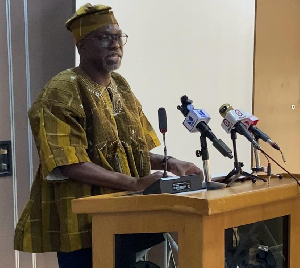 Dr Dominic Hoedoafia, Executive Secretary of the IMCC