The Governor of the Bank of Ghana, Dr Johnson Pandit Asiama, has warned that the ongoing conflict in the Middle East and rising global energy prices are posing fresh risks to Ghana’s economic recovery, despite signs of improved macroeconomic stability.
Speaking at the opening of the 130th Monetary Policy Committee (MPC) meeting in Accra on Monday, May 18, 2026, Dr Asiama said the Ghanaian economy had made meaningful progress since the Bank’s last MPC meeting in March 2026.
However, he cautioned that worsening global conditions could threaten the gains achieved so far.
No compensation for DDEP losses - Dr Ato Forson rules out payouts to bondholders
He noted that the external environment had become increasingly challenging due to the protracted Middle East crisis.
“The conflict has not abated, and its economic consequences are now visible in the global data,” Dr. Asiama said, adding that the closure of the Strait of Hormuz had triggered a sustained surge in global energy prices.
According to him, the International Monetary Fund (IMF) has revised its 2026 global growth forecast downward from 3.3% to 3.1%, citing the adverse effects of the conflict on global demand and supply chains.
He explained that for Ghana, which exports commodities but imports energy, the external shock is likely to affect fuel prices, transportation costs, import bills, and inflation.
Dr Asiama disclosed that inflation in Ghana had recorded its first increase since December 2024, while the country continues to grapple with domestic energy supply disruptions and global commodity price pressures.
Despite these challenges, the Governor highlighted several positive developments in the economy, including an improved current account position, growing investor confidence, and government efforts to reduce dependence on external borrowing.
“The Q1 2026 current account surplus exceeded the Q1 2025 outturn by approximately US$652 million,” he revealed.
He also pointed to the successful issuance of a seven-year government bond and the resumption of domestic bond issuance as signs of renewed investor confidence.
Dr. Asiama further noted that the government intends to raise US$1 billion through local currency bonds to finance cocoa purchases for the 2026/27 crop season, describing it as a major shift away from reliance on dollar-denominated funding and foreign lenders.
On the IMF programme, he disclosed that a mission that visited Ghana from April 29 to May 15 had concluded discussions on the sixth and final review of the Extended Credit Facility (ECF) programme, as well as negotiations for a new 36-month non-financing Policy Coordination Instrument (PCI).
He said the PCI represents a “considered and credible next step” in Ghana’s engagement with the international financial architecture, preserving the signalling benefits of IMF engagement while strengthening national ownership of reforms and reducing financial dependence on IMF resources.
The Governor explained that the new PCI arrangement would focus on sustaining fiscal discipline, safeguarding debt sustainability, strengthening monetary policy, and reinforcing financial sector stability.
He added that discussions at the MPC meeting would focus on inflation risks, interest rate decisions, and measures to strengthen the banking sector and support credit growth.
“These risks will be central to the discussions this week,” Dr. Asiama stressed, referring to concerns over rising energy prices, inflation expectations, fiscal pressures, and ongoing domestic power challenges.
SO/MA
'Konica printers offer affordable cost per print' – Richard Gyimah
video=137773>
Business News of Monday, 18 May 2026
Source: www.ghanaweb.com
Middle East tensions pose fresh risks to Ghana's economic outlook - BoG
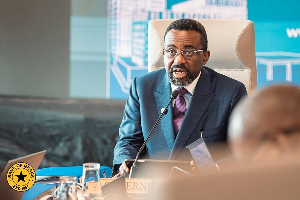 Dr Johnson Pandit Asiama is Bank of Ghana Governor