In December 2008, at the height of a global financial crisis, Bernard Lawrence Madoff — former chairman of the NASDAQ stock exchange, founder of one of Wall Street’s most respected market-making firms, and a man whose address book read like a who is who of American high society, confessed to his sons that his celebrated investment advisory business was, in his own words, “one big lie.
The lie, it turned out, had been running for decades. Clients’ account statements showed balances totalling approximately US$65 billion. The actual cash losses to investors were estimated at around US$17 billion. Not a single trade had been placed.
Madoff’s sons reported him to the FBI the following morning. He was arrested, charged with eleven federal felonies, and in 2009 sentenced to 150 years in prison, a term he began serving at age 71.
He died behind bars in April 2021.
The scheme he ran was not especially sophisticated in its underlying logic. He simply deposited client funds into a single Chase Manhattan bank account, fabricated trade confirmations and monthly statements, and paid ‘returns’ to existing clients using money deposited by new ones.
The same mechanism first described by Charles Ponzi in the 1920s. What made Madoff’s version exceptional was not the method but the camouflage, viz., decades of genuine credibility, impeccable social connections, and regulators who received credible warnings as early as 1999 and failed to act on any of them.
A familiar architecture
Strip away the Manhattan penthouse and the Palm Beach country club membership, and the architecture of Madoff’s fraud is nearly identical to what unfolded in the-then Brong-Ahafo region of Ghana a decade later.
In 2015, DKM Diamond Microfinance Company Limited was offering investors returns of between 50 and 80 per cent — rates that fluctuated depending on the need to attract fresh deposits, competition from rival schemes operating in the same communities, and periodic pressure from the Bank of Ghana (BoG) to bring them down. These were not investment returns. They were recruitment incentives, funded by the deposits of whoever came next.
DKM concentrated its operations across the Bono, Bono East, Upper West, and Upper East regions, areas where formal banking penetration was limited and where trust in community-based financial institutions ran deep. Its marketing was explicitly religious in register, with posters bearing slogans such as “I tell you, DKM is the tree, and the fruit is DKM’s products.”
Investors were not strangers to the concept of loss; they were strangers to the idea that an institution this embedded in their community, this apparently blessed, could be fraudulent. By the time the BoG moved to close it in 2016, large segments of the population in surrounding regions had lost their savings. Many had liquidated legitimate bank deposits. Some had taken loans specifically to invest.Financial Literacy Courses
Gold, glamour, and the Menzgold collapse
If DKM drew on religious community trust, Menzgold Company Limited — the nation’s most politically combustible financial scandal in recent memory — weaponised aspiration and celebrity.
Founded by Nana Appiah Mensah, known publicly as NAM1, the Accra-based gold trading and export company attracted investors from across Ghana’s middle class with promises of high returns underpinned by what it presented as a legitimate gold dealership business.
The Securities and Exchange Commission (SEC) had been raising alarms since 2018. Menzgold’s operating licence did not cover the deposit-taking and investment activity it was conducting.
The warnings were largely ignored by the company, and by many investors who viewed regulatory caution as politically motivated interference. Heck, anyone who raised genuine warning was heckled for not wanting to see a young, forward-thinking man flourish or for committing the mortal crime that is poverty.
However, the parallels with Madoff here are almost uncomfortable. Madoff’s victims, mostly wealthy individuals, hedge funds, Jewish charities, European feeder funds, largely disregarded the concerns of the one analyst who ran the numbers publicly, Harry Markopolos, who submitted a 29-page memo to the SEC in 2005 titled ‘The World’s Largest Hedge Fund is a Fraud’.
The SEC conducted two examinations and found nothing. Menzgold’s investors similarly trusted the company’s performance narrative over the regulator’s warnings. In both cases, the regulator’s credibility was the casualty, even more than the scheme’s.
A deep and recurring history
DKM and Menzgold are the most prominent entries in a catalogue that stretches back to at least the 1990s. Earlier schemes operating under names such as Pyram, Resource 5, Unique Shepherd, Savanna Gold, Jastar Motors, DG Capital, and Safeway Investment Group each exploited similar conditions; limited investor financial literacy, attractive headline returns well above anything available from regulated institutions, and regulatory frameworks that were either underpowered or slow to respond.
The 2015 cluster alone, which included Little Drops Financial Services, God is Love Fun Club, and Care for Humanity Fun Club alongside DKM, was offering annualised returns exceeding 40 percent at a time when the government’s own risk-free securities yielded around 24 to 25 percent. (Talk of the sustainability of ‘risk free’ Treasury instruments at those rates are matters for another day).
The macroeconomic fallout was significant. Investors withdrew legitimate savings from commercial banks to place in these schemes, directly contributing to the liquidity stress that cascaded through the financial sector between 2017 and 2019.
The BoG’s eventual response in the revocation of licences for 23 savings and loans companies and finance houses in 2019, and the SEC’s revocation of licences for 53 fund management companies the same year, was as much a consequence of the schemes’ damage to the broader system as it was a targeted enforcement action.
The anatomy of belief
Ponzi schemes endure not because investors are irrational but because the schemes are, for a time, indistinguishable from legitimate high-yield investments; particularly in environments where high returns are genuinely available and where trust in formal institutions is low.
Madoff’s genius, such as it was, lay in never appearing too greedy. He offered steady returns of 10 to 12 percent annually, modest enough to seem plausible, consistent enough to seem real. Ghana’s schemes went the other way, extraordinary headline rates that nonetheless found willing investors in communities where a generational accumulation of institutional disappointment had eroded confidence in the formal system entirely.
In both contexts, the social architecture around the fraud was as important as the financial mechanics. Madoff recruited primarily from Jewish philanthropic and social networks — what fraud scholars call affinity fraud, targeting a community through shared identity and mutual trust.
DKM’s agents described their work as ‘normal banking’. Investors remembered DKM’s founder, Martin Agyei Boateng, fondly even after the collapse, some long after they had abandoned any realistic hope of recovering their money. The community bonds that made the scheme credible were the same ones that softened the anger when it failed.
What remains
Bernie Madoff died in federal prison on April 14, 2021 (and would have been 88 on April 29, 2026) having served thirteen years of a sentence that was, in mathematical terms, a life sentence several times over.
A court-appointed trustee, had recovered more than US$14.7 billion for victims, a remarkable recovery rate by any historical standard, though thousands of investors, particularly smaller depositors, saw pennies on the dollar. In Ghana, the resolution of DKM claims was handled through a government-backed validation process; Menzgold’s victims are, in many cases, still waiting.
The lesson that both cases press, and that both sets of regulators failed adequately to absorb before the damage was done, is not primarily about greed. It is about the gap between the speed at which trust is extended and the speed at which institutions can verify whether that trust is warranted.
Charles Ponzi understood that gap in 1920. Bernie Madoff exploited it for the better part of four decades. Ghana’s serial experience with the same mechanism suggests that closing that gap requires more than periodic licence revocations and post-collapse task forces. It requires a financial regulatory culture that treats the impossibly attractive return not as a matter for investor discretion, but as a standing emergency.
Business News of Sunday, 3 May 2026
Source: thebftonline.com
How Bernie Madoff stole billions in history's biggest Ponzi scheme
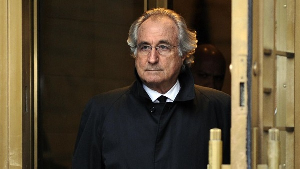 Bernard Lawrence Madoff is the former Chairman of NASDAQ stock exchange