Fishers, scientists, regulators, and community leaders last Tuesday convened at the University of Ghana to launch the Fisheries Without Borders (FWB) project, a regional initiative aimed at tackling rapidly declining fish stocks.
The project launch, which also included a policy dialogue, revealed deeper concerns about the challenges coastal communities face in sustaining their livelihoods and the failure of governments to respond effectively.
The Fisheries Without Borders initiative, funded by Rockefeller Philanthropy Advisors through the Blue Convergence Fund, led by the Federal University of Technology Akure (FUTA) in Nigeria, operates across Ghana, Nigeria, and Benin and will run from 2026 to 2027.
The University of Ghana's Department of Marine and Fisheries Sciences and the Wildlife and Human Resource Organisation serve as partners.
According to organisers, the project could expand across West Africa if its initial two-year phase proves successful.
At its core is a pressing challenge as fish stocks move freely across national boundaries, but policies and enforcement mechanisms remain fragmented.
Prof. F.K.E Nunoo, Ghana country Lead discusing the scale of the decline said "there were were times we got 900,000 tonnes from marine fisheries. Now we are at 400,000 and it is still going down"
Ghana’s meeting followed similar dialogues in Benin and Nigeria, forming part of a broader effort to gather grassroots insights before shaping policy responses.
Project lead Dr. Toyosi, speaking virtually, emphasised that the initiative aims to improve marine ecosystems, update policy frameworks, and strengthen climate resilience in coastal communities.
Participants called for mandatory representation of women in fisheries governance bodies, alongside improved access to cold storage and processing facilities through affordable financing.
They also mentioned the need to document traditional ecological knowledge, particularly from older women, whose experience remains largely untapped.
Representatives of the Environmental Protection Authority pointed to Ghana’s new EPA Act as evidence of strengthened legal backing for climate action while the Fisheries Commission, the Fisheries Committtee for the West Central Gulf of Guinea (FCWC), reprinting six countries also endorsed the project's regional approach.
General News of Saturday, 2 May 2026
Source: Ebenezer Amponsah, Contributor
Fisheries without borders project launched to tackle declining fish stocks
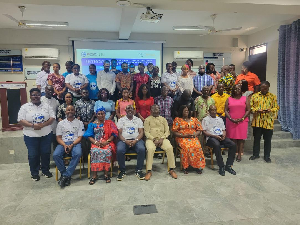 Some of the stakeholders at the event