Tinah Mukunda, National Director of World Vision Ghana, has unveiled a bold five-year strategy to transform the lives of vulnerable children across Ghana.
Speaking at a press conference on April 13,2026, Mukunda announced that the strategy—dubbed “Hope for Every Child” (2026–2030)—will reach 2.8 million children, focusing on their protection, education, health and overall well-being.
She described the plan as the result of extensive research and nearly five decades of community-based work since the organisation began operations in 1979. Currently, World Vision Ghana operates in 43 districts across 14 regions, partnering with government, communities and development stakeholders.
According to her, the new strategic direction focuses on strengthening child well-being by addressing key areas such as education, health, protection, and participation, while also building resilient families and communities.
She explained that the strategy is built on four pillars: impactful programming, sustainable funding, operational excellence, and people development, while aligning with Ghana’s national development agenda and the Sustainable Development Goals.
She noted that the changing global funding landscape has made it necessary for organizations to rethink how they mobilize resources, stressing that World Vision Ghana is positioning itself to adapt through diversified funding streams.
She further indicated that the strategy aligns with Ghana’s national development agenda and the global Sustainable Development Goals, as the world approaches the final phase of their implementation.
She called for stronger partnerships to tackle child vulnerability and poverty, stressing that investing in children is critical to the country’s future.
Children are the future of this country, and investing in them is not optional it is essential,” she emphasized.
Meanwhile, Joshua R. Baidoo, Strategy and Integrated Programmes Director, highlighted that the new plan adopts an integrated approach, combining sectors such as health, nutrition, education, WASH and livelihoods.
He noted that child-related challenges are interconnected and require holistic solutions.
The strategy will expand community healthcare, strengthen early childhood education, improve water and sanitation access and promote economic empowerment, especially for women and youth.
Baidoo added that child protection, gender equality and climate-responsive programming will cut across all interventions.
He cited data indicating that 2.4 million children under five are stunted, one in four children lives in poverty, and over 768,000 children are engaged in child labour, underscoring the urgency of the initiative.
On funding, Joseph Appiah said the organisation aims to mobilise $120 million for the strategy period, building on the $101 million raised between 2021 and 2025.
He revealed plans to secure at least 40% of funding locally through innovative financing models, including blended finance, private sector partnerships, diaspora contributions, and community sponsorship initiatives.
Appiah also noted that World Vision Ghana will explore social enterprise opportunities, leveraging assets such as its water laboratory to generate revenue while delivering services.
The official launch of the “Hope for Every Child” strategy is expected to take place on Wednesday, April 15, 2026, at the Mövenpick Hotel, Accra.
Dr Nyaho Nyaho-Tamakloe on Ghana's past, present and the road ahead
General News of Monday, 13 April 2026
Source: Beyonce Diamond, Contributor
World Vision Ghana targets 2.8 million children with new ‘hope for every child’ strategy
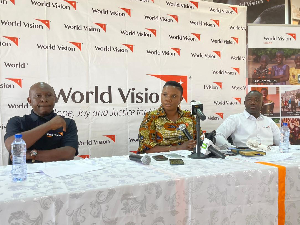 Some of the stakeholders at the event