A former Criminal Investigations Department (CID) officer of the Ghana Police Service, Corporal Emmanuel Sackey, who was once sentenced to death by firing squad, has recounted a series of incidents during his time at the Nsawam Prison.
Sackey, who was convicted alongside his colleague, Constable Yaya, initially sentenced to 25 years’ imprisonment as an accomplice following the death of a suspect in police custody in 1985, emphasised that prison is not a place anyone should wish to experience.
He shared an incident involving inmates who lost their amnesty after delaying their release to engage in drinking.
In an interview with NAK Media on March 31, 2026, Sackey, who hails from Somanya, detailed the events that led to his conviction and eventual pardon.
“We were called and informed that a letter had arrived from the presidency, so we should gather and listen. When we assembled, we were asked to pray, after which the letter was read to us, stating that we had been granted a presidential pardon and should go for our belongings and prepare to go home.
“However, when we returned to collect our things, we were told it was late and that we had to wait until the next day. We began to wonder, what if we went to sleep and the president changed his mind?
“There had been a similar incident at Nsawam Prison where some inmates were granted pardon. When they reached the main gate, some left immediately but others decided to stay back and go drinking at the canteen. While they were still drinking, another letter arrived stating that if they had not yet left then they should wait and shouldn’t go again. Meanwhile, those who had left earlier were already gone,” he recounted.
Sackey also narrated his final days in prison after being granted presidential amnesty and outlined the processes involved in securing his release.
According to him, he struggled with substance abuse during his time in service, including alcohol and drugs. He explained that the incident leading to his conviction occurred after he had consumed both heavily before being assigned to handle a case.
During interrogation, the suspect became uncooperative, resulting in a physical altercation.
“The suspect was frustrating me, so I slapped him. He attempted to retaliate, and Yaya said, ‘Not here,’ and joined me. We beat him. He had previously undergone surgery, and after the assault, he was injured and began bleeding,” Sackey recounted.
The suspect later collapsed, and efforts were made to rush him to the hospital.
“He collapsed, and we put him in a car to take him to the hospital, but he died on the way. That was when I became fully conscious of the effects of the weed and alcohol I had taken,” he said.
At Tema General Hospital, medical personnel confirmed that the suspect was dead on arrival. The incident was subsequently reported to their superiors, and the family of the deceased was informed.
Public outrage over the case escalated the matter to the then Head of State, Jerry John Rawlings.
“People believed that if the case was handled internally by the IGP, we might be freed, so they took the matter directly to the President at the Castle,” Sackey claimed.
According to him, Rawlings directed the Inspector-General of Police to take immediate action.
“The President ordered the IGP to bring a delegation from Accra to Tema to arrest all of us,” he said.
How a police officer who appealed his 25-year jail term ended up with a death sentence
Sackey and his colleague were subsequently charged with murder and conspiracy and tried before a special tribunal. Sackey was sentenced to death by firing squad, while Yaya received a 25-year prison sentence.
After serving 10 years, both men filed appeals to have their sentences reduced. Sackey’s appeal was dismissed, while Yaya’s attempt reportedly angered the presiding judge.
“The judge said both of us committed the crime, so instead of reducing his sentence, he reviewed it and handed him a death sentence as well,” Sackey explained.
This decision led to accusations that Sackey had influenced the outcome of Yaya’s appeal.
After spending 16 years in prison, both men were eventually granted a presidential pardon on January 12, 2001.
AM
Dr Nyaho Nyaho-Tamakloe on Ghana's past, present and the road ahead
General News of Wednesday, 8 April 2026
Source: www.ghanaweb.com
Ex-CID officer recounts how some prisoners lost amnesty moments after going to drink
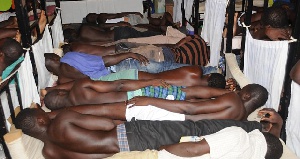 File photo of a jailed person




Entertainment