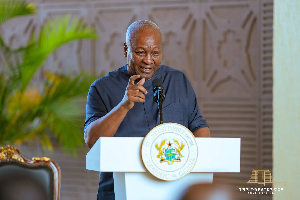
Augustus Goosie Tanoh, Presidential Adviser on the 24-Hour Economy and Accelerated Export Development, has called for a fundamental shift in Ghana’s economic structure from an import-driven model to a vibrant manufacturing-led economy that creates value across the production chain.
He said the country continued to consume far more than it produced, a situation that was draining foreign exchange and limiting job creation.
Tanoh made the call at the opening ceremony of the 2026 Kwahu Business Forum at Mpraeso Hills in the Eastern Region.
He observed that many products that could be competitively produced locally, including garments, pharmaceuticals, processed foods, building materials, and household items, were still being imported.
“Too much of our economic activity remains concentrated in trading and import distribution. We consume more than we produce. Every container that arrives represents jobs we did not create and foreign exchange we did not retain,” he said.
Citing data from the Ghana Statistical Service, Tanoh said Ghana spent GH¢39 billion in 2024 importing food items such as rice, frozen chicken, sugar, cereals, and animal offal.
“According to the Ghana Statistical Service, in 2024 we spent GH¢39 billion importing food items such as rice, frozen chicken, sugar, cereals, and even animal stomachs and guts—products we have the capacity to produce locally,” he said.
Tanoh also expressed concern that Ghana’s export structure had remained largely unchanged for more than a century.
He noted that over 80 per cent of the country’s exports still consisted of three primary commodities, a pattern similar to that of the early 20th century when Ghana’s main exports were gold, timber, and cocoa beans.
He said the country’s failure to transform into a production hub was depriving it of critical foreign exchange earnings and employment opportunities.
“We earn foreign exchange from exporting raw materials and then spend it importing the very goods we could produce ourselves,” he said.
Tanoh explained that the 24-Hour Economy and Accelerated Export Development programme had been designed to reverse that trend by strengthening Ghana’s productive capacity.
He said the initiative sought to build production infrastructure in partnership with the private sector to enable Ghanaian businesses to manufacture, process, and export at scale.
He noted that the government was working to establish industrial parks and shared infrastructure, including utilities and logistics systems, to significantly reduce the cost of manufacturing.
Tanoh, therefore, urged businesses and stakeholders participating in the forum to partner with the government to drive the country’s industrial transformation and position Ghana as a competitive production and export hub.
The 2026 Kwahu Business Forum has brought together business leaders, investors, policymakers, and entrepreneurs to deliberate on strategies to accelerate economic growth in the Eastern Region and across Ghana.
Business News of Saturday, 4 April 2026
Source: peacefmonline.com
Ghana spent GH¢39 billion on food imports in 2024 - Goosie Tanoh
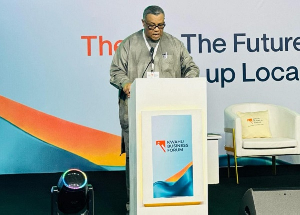 Augustus Goosie Tanoh is the Presidential Adviser on the 24-Hour Economy policy