Andowa Ama Buabeng of the Takoradi Technical University (TTU) has made history, becoming the first deaf student to graduate with a Master’s degree from a technical university in Ghana.
She has earned her postgraduate qualification in Graphic Design. Her achievement is being widely celebrated as a major step forward for inclusive higher education.
Her success has drawn commendation from education stakeholders and government officials, who say it demonstrates how access to education can transform lives when barriers are removed.
Technical Adviser at the Ministry of Education, George Kweku Toku Oduro, described the feat as a significant milestone, noting that it reflects both the student’s determination and the importance of inclusive educational policies.
According to him, the success also aligns with government initiatives aimed at improving access to tertiary education for persons with disabilities. He referenced interventions such as the Free Tertiary Education policy for Persons with Disabilities, designed to reduce financial barriers and expand opportunities for qualified students.
Beyond her personal achievement, TTU itself has been recognised for strengthening its academic reputation.
The university was recently ranked the top technical university in Ghana in the AD Scientific Index 2025. Officials say the institution’s stable academic environment and leadership have played a key role in its progress.
University authorities also highlighted ongoing efforts to promote inclusive learning. Since establishing a dedicated disability support unit in 2018, more than 170 students with disabilities have benefited from programmes including scholarships, assistive technologies, sign language training, and flexible learning systems.
Vice-Chancellor John Frank Eshun reaffirmed the university’s commitment to creating an environment where all students can thrive, regardless of physical ability.
Speaking at TTU’s 26th Special Congregation, where more than 2,000 students graduated, stakeholders emphasised that inclusive education is critical to national development. Graduates were encouraged to apply their knowledge to solve societal challenges, promote innovation, and advocate for inclusion in their fields.
Government representatives also reiterated ongoing efforts to reduce financial pressures on students through initiatives such as the “No Fees Stress” policy, aimed at ensuring that economic challenges do not prevent qualified students from pursuing higher education.
While acknowledging challenges such as staffing constraints, university officials indicated that measures are being taken to address them as TTU expands its academic programmes and competency-based training initiatives.
General News of Monday, 30 March 2026
Source: www.ghanaweb.com
TTU student makes history as first deaf graduate with Master's Degree
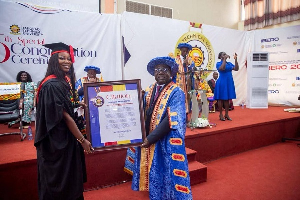 Andowa Ama Buabeng has made history as the first student of TTU to graduate with a Master's Degree