The left-back position for the Ghana national football team has, for years, felt like a seat quietly occupied rather than fiercely contested.
From the days of Hans Adu Sarpei to Kwadwo Asamoah, and later Baba Rahman, the role has always found a natural owner, until circumstances disrupted the order.
For a long stretch, Rahman looked set to dominate that flank. But football can be cruel. A devastating injury derailed his momentum, and when he returned, inconsistency crept in.
The frustration peaked during Ghana’s clash with Central African Republic national football team in the 2023 AFCON qualifiers, where fans turned on him.
I’ll make it impossible for Otto Addo to drop me – Arthur Kohn
Since then, he has drifted out of the picture.
That vacuum didn’t stay open for long.
Gideon Mensah stepped in, not with noise, not with overwhelming brilliance, but with reliability.
And sometimes, that’s enough at international level. He became the constant.
From the 2022 FIFA World Cup to the 2026 World Cup qualifiers and the 2025 AFCON qualifiers, Mensah has been the name penciled in at left-back almost by default.
Not elite, perhaps. But trusted.
For a while, it seemed like competition had faded. Even when options like Alidu Seidu were considered, they never quite displaced him.
The position became his, not through dominance, but through absence of a genuine challenger.
Until now.
Enter Derrick Köhn.
German-born, dynamic, and now fully committed to Ghana after completing his nationality switch, Köhn arrives with something Ghana’s left flank has lacked for years: momentum.
His introduction isn’t theoretical; he already featured in the Kirin Cup clash against Japan in November 2025.
This isn’t a trial. It’s the beginning of a push.
And the numbers? They tell a compelling story.
At Union Berlin, Köhn has quietly built a strong Bundesliga season, 25 appearances, a goal, and an assist, with the club sitting comfortably mid-table.
But beyond surface stats lies the real intrigue.
Defensively, he looks sharp and secure. Across 372 passing metrics, he boasts a 78.2% action success rate, 33 tackles, 8 interceptions, and crucially, zero errors leading to goals.
He’s been dribbled past just once. That last stat alone stands out. It speaks of positioning, awareness, and one-on-one strength.
Compare that to Mensah.
At AJ Auxerre, battling relegation in Ligue 1, Mensah’s numbers reflect a player constantly under pressure.
He has made 43 tackles and 26 interceptions, higher defensive involvement, but has been dribbled past 18 times.
That suggests exposure, yes, but also vulnerability in isolation.
Yet Mensah offers something Köhn is still building at the international level: familiarity and trust.
His 709 accurate passes at 82% accuracy show composure in buildup. His 13 key passes and 17 successful dribbles highlight a willingness to push forward.
Even if his crossing accuracy (21.2%) isn’t exceptional, he contributes to progression in ways that managers value.
Köhn, on the other hand, offers efficiency over volume. Fewer crosses, but a slightly better accuracy (24.5%). Fewer defensive actions, but cleaner execution.
He feels like a modern full-back, measured, athletic, and less chaotic.
So, is this finally a real battle?
Yes, but it’s not straightforward.
Mensah still holds the shirt. Experience, continuity, and tournament exposure give him the edge.
Coaches trust what they know, especially in international football, where time is limited.
But Köhn changes the conversation.
For the first time in years, Mensah isn’t just maintaining his place, he has to defend it.
And that psychological shift matters. Competition sharpens decisions, raises performance levels, and forces accountability.
The question isn’t whether Köhn can replace Mensah immediately.
It’s whether he can apply enough pressure to transform the position from a settled role into a contested one. And based on current evidence, he already has.
For the Black Stars, that might be the biggest win of all.
FKA/JE
Watch as Ghanaians blast CAF over decision to strip Senegal of AFCON title
Sports News of Monday, 23 March 2026
Source: www.ghanaweb.com
Can Derrick Köhn threaten Gideon Mensah’s grip on Black Stars Left-back slot?
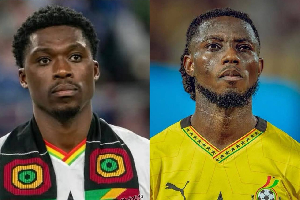 Derrick Köhn (L) and Gideon Mensah (R) will compete for the Black Stars left back position