The Director of Communication for the United Party, Solomon Owusu, has stated that the government has no reason to relent in efforts to absorb any shocks that may arise amid the ongoing US–Israel–Iran conflict.
Speaking on GTV’s Morning Show on Tuesday March 17, 2026, Owusu stressed that while external crises may disrupt economies worldwide, it remains the responsibility of the government to shield citizens and explore creative options to stabilise the economy.
His comments come against the backdrop of escalating tensions involving the United States, Israel and Iran; a conflict rooted in long-standing geopolitical tensions in the Middle East.
The crisis which has intensified in recent weeks, has raised concerns due to global oil supply disruptions leading to a hike in fuel prices.
The issue has resulted in broader economic uncertainty, particularly for developing economies like Ghana that are vulnerable to external shocks.
Despite these challenges, Owusu argued that Ghana is not without advantage.
“It’s the government’s duty to manage the economy well regardless of external factors,” he said.
Comparing Russia-Ukraine and US-Iran conflicts is 'illiteracy' – Kwesi Pratt Jnr
“Ghana is a net exporter of crude, so if there’s an external shock, it is expected that the government will harness this to address the situation,” he added.
He maintained that governance in a democratic setting goes beyond reacting to crises, insisting that leaders must proactively plan for uncertainties.
According to him, governments must consistently anticipate global disruptions and assemble the right expertise to navigate them.
“In a democracy, it is government’s duty to provide basic necessities for citizens,” he noted.
“That is why the government must employ the best brains to solve the problems of the country and prepare for shocks every now and then,” he emphasised.
Owusu lamented Ghana’s heavy dependence on imports, describing it as a major weakness that undermines economic resilience.
“We are too import-driven when we can produce some of these goods locally,” he said. “What does it take to grow rice in this country? We have fertile lands. To the extent that we import tomatoes, we go to Burkina Faso to buy tomatoes. What about Niger? Do they have better lands than Ghana?”
While acknowledging efforts by the government to stabilise the economy, he cautioned that the government must explore all possible means to sustain the gains made over the past year.
“This government has done well by stabilising the economy, but beyond that it must translate into transformation,” he stated.
He further highlighted the need for Ghana to maximise value from its natural resources and expand its economic base.
Comparing Ghana with other countries, Owusu pointed out that while Ghana earns about $2 billion from cocoa, Malaysia generates nearly $20 billion from palm oil.
“We must expand our economy and tackle the basics,” he emphasised.
His remarks underscore a growing call for Ghana to move beyond short-term economic management and focus on long-term structural transformation, especially at a time when global conflicts continue to test the resilience of smaller economies.
SO/VPO
Meanwhile, watch as officials at TMA Day Care 3 speak following Tema helicopter crash:
General News of Tuesday, 17 March 2026
Source: www.ghanaweb.com
'Insulate the economy now' - Solomon Owusu warns government over war fallout
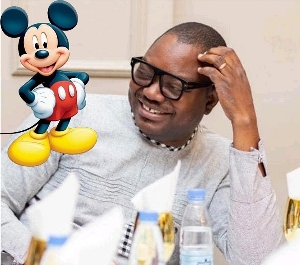
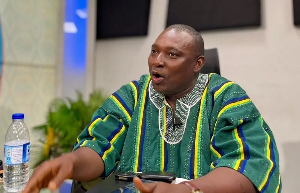 Solomon Owusu is the Director of Communication for the United Party