The Ghana Private Road Transport Union (GPRTU) has cautioned passengers to prepare for possible increases in transport fares if fuel prices continue to rise at the pumps.
According to the Union’s Industrial Relations Officer, Abass Imoro, fuel costs are not the only factor influencing fares.
The prices of spare parts, lubricants, and other materials required for vehicle maintenance also play a significant role in determining transport charges.
Speaking to Citi News on Sunday, March 15, 2026, Imoro noted that transport operators are already feeling the strain of rising operational costs.
“We work for profit, and for some time now prices have remained the same. Some of our members even tried to increase fares, but we stopped them. This shows that they are under pressure and looking for a change,” he explained.
He added that fare adjustments are not made arbitrarily but are tied directly to fuel price movements.
Here’s how much government ‘lost’ in latest T-bills auction
“We do not immediately impose a new fare, but if the price of fuel changes and it is upwards, everybody should expect a change in lorry fare,” he stated.
He further said; “We spoke about the prices of spare parts, lubricants and other things we use on our cars, but their prices have remained high. So these are the indicators we look at.”
Meanwhile, some Oil Marketing Companies (OMCs) have already begun adjusting fuel prices at the pumps from Monday, March 16, 2026.
Industry data shows that petrol’s price floor has increased to GH¢11.57 per litre from GH¢10.46 per litre recorded between March 1 and 15.
Diesel’s price floor has also risen sharply to GH¢14.35 per litre from GH¢11.42 per litre, while liquefied petroleum gas (LPG) has climbed to GH¢10.67 per kilogramme from GH¢9.38 per kilogramme.
These sharp increases in fuel prices are expected to intensify calls for fare adjustments, as transport operators struggle to balance rising costs with affordable services for passengers.
SA
Auto dealers respond to 15% price cut announcement
Business News of Monday, 16 March 2026
Source: www.ghanaweb.com
GPRTU explains what goes into transport fare pricing
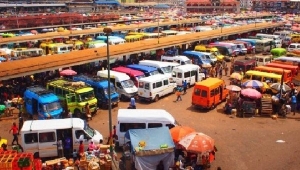 Bus conductor calling for passengers