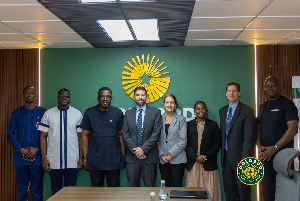
The Director of the Presidential Initiatives in Agriculture and Agribusiness (PIAA), Peter Boamah Otukunor, has advised young people to view agriculture as a viable business capable of meeting their economic needs.
Dr Otukunor gave the advice during the 11th National Rastafari Conference held in Kumasi.
In a speech read on his behalf by Mr. Emmanuel Owusu, Programmes Coordinator at PIAA, Dr. Otukunor outlined several initiatives his directorate has introduced and plans to roll out. He also urged the Rastafari Council Ghana to take advantage of the opportunities for the benefit of its members.
He disclosed that the directorate has so far distributed more than three million coconut seedlings to farmers across the country.
Dr Otukunor added that upcoming initiatives include Youth in Cocoa Farming, Youth in Aquaculture, and the Youth Agriculture Estate Programme.
According to him, the PIAA has also established a partnership with Maphlix Trust Ghana Ltd to implement a vegetable outgrower scheme covering approximately 6,000 acres of vegetable production across selected regions.
Through this partnership, farmers will receive inputs, technical support, irrigation assistance, and structured market access, enabling year-round vegetable production for both domestic and international markets.
He emphasised that these initiatives are designed to drive accelerated economic transformation and strengthen food security in the country.
The President of the Rastafari Council Ghana, Ahuma Bosco Ocansey, said the theme for this year’s conference — “Sustainable Agribusiness: Support and Access” — was chosen to unite Rastafari minds for economic empowerment through ethical farming rooted in Ital principles and self-reliance.
While applauding the government for passing legislation allowing the cultivation of hemp for industrial and medicinal purposes, he called for an urgent review of the hemp licensing process to remove barriers, ensure fair access, and boost local production.
He said the council supports a legal action filed by a farmer in Techiman, Mariam Alhassan, through her lawyer Amanda Clinton, seeking a court order directing the government to withdraw the current licensing regime and replace it with a tiered system.
According to him, such a system would enable ordinary farmers to cultivate hemp and benefit from the economic opportunities associated with its medicinal and industrial uses.
“It’s essential to cut the red tape to unlock the export potential of the hemp plant and ensure economic justice, because the current licensing regime keeps ordinary farmers out,” he said.
In a separate statement, New York-based attorney Marina Blake urged participants to uphold strong family values, noting that a strong family forms the foundation of a strong nation.
The conference was preceded by a tree-planting exercise at the Rastafari Unification Foundation Camp at Lake Bosumtwi and the Rastafari Repatriation Camp at Mpataase.
Both camps were represented by their leaders, Nana Antwi Bosiako and King Yankee respectively, with Rastafari members from across the country in attendance.
Business News of Wednesday, 11 March 2026
Source: Ahuma Bosco Ocansey, Contributor
Dr Otukunor encourages youth to venture into agribusiness
 The conference was preceded by a tree-planting exercise